2017 RAV4 Transmission Problems and Fixes

By the CarsDailyHub Editorial Team | Automotive writers; every article fact-checked against OEM service documentation and owner-reported data | Updated June 2026
Quick Answer: The 2017 Toyota RAV4 uses a 6-speed automatic that is mechanically robust, so most complaints are about shift feel rather than failure: hesitation when accelerating, harsh or clunky downshifts, and a lurch or jerk at low speed. These are most often calibration and fluid related, and a transmission software update plus a correct fluid service resolves many cases. True internal failure on this transmission is relatively uncommon.
This guide covers the 2017 Toyota RAV4 with its 2.5L engine and 6-speed automatic (the RAV4 Hybrid uses a different eCVT system). Last reviewed: June 2026.
Table of Contents
- The 2017 RAV4 Transmission
- Common Problems and Symptoms
- What Causes Them
- How These Problems Get Fixed
- Maintenance and Prevention
- Is It Safe to Drive?
- Frequently Asked Questions
- Sources & References
The 2017 RAV4 Transmission
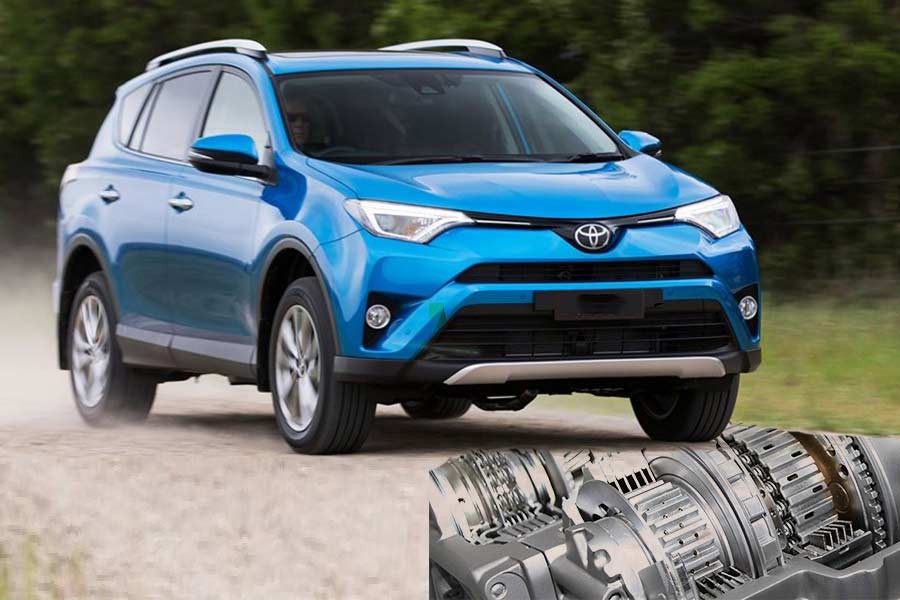
The 2017 RAV4 (gas model) pairs the 2.5L four-cylinder with a 6-speed automatic. It is a conventional geared automatic with a torque converter, not a CVT, and it has a generally good durability record. That is important context: most 2017 RAV4 transmission complaints are about how it shifts, not about it breaking.
Because so many concerns are calibration-based, the fixes often involve software and fluid rather than major internal repair, which is good news for owners.
Common Problems and Symptoms
| Symptom | What owners describe |
|---|---|
| Hesitation | A pause or lag before the car accelerates, especially from low speed |
| Harsh / clunky shifts | A firm bang or jolt, often on downshifts or 2-1 |
| Lurching at low speed | The car jerks in slow traffic or when easing off and on the gas |
| Delayed downshift | A slow kickdown when you need to accelerate to pass |
| Shift flare | Engine revs briefly climb between gears |
These behaviors are most noticeable at low speed and during light-throttle, stop-and-go driving.
What Causes Them
- Shift calibration: The transmission control programming prioritizes fuel economy, which can feel like hesitation or a reluctance to downshift. Toyota has issued calibration updates for shift-quality concerns on various models.
- Fluid condition: Degraded or incorrect fluid affects shift smoothness and clutch engagement.
- Adaptive learning: The transmission adapts to driving style over time; after a battery disconnect or repair it may shift oddly until it relearns.
- Throttle/engine response: Some perceived “transmission” hesitation is partly throttle mapping rather than the gearbox itself.
- Rarely, mechanical: Genuine internal faults (solenoids, torque converter) are less common on this unit but possible at higher mileage.
How These Problems Get Fixed
- Scan for codes. No codes with a shift-feel complaint points to calibration or fluid; stored codes point to a specific component.
- Check for software updates. A dealer can check for applicable transmission control calibration updates that improve shift quality.
- Service the fluid with the correct Toyota ATF (such as Toyota WS) if it is overdue or degraded, using the proper fill-and-level procedure.
- Allow relearn. After updates or service, the transmission may need a number of drive cycles to relearn smooth shift points.
- Diagnose components only if codes or persistent symptoms indicate a solenoid, valve body, or torque converter issue.
Most owners find the software-and-fluid path resolves or greatly improves the complaint.
Maintenance and Prevention
- Service the transmission fluid per Toyota’s guidance, and sooner under severe use (heavy loads, towing within limits, hot climates, constant stop-and-go).
- Use only the correct Toyota ATF; do not substitute a generic fluid.
- Address shift complaints early at a dealer so any calibration update gets applied.
- Avoid riding the brakes and throttle together in traffic, which can amplify low-speed lurching.
Is It Safe to Drive?
In most cases the 2017 RAV4 with these symptoms is safe to drive, the issues are about comfort and refinement rather than a failing transmission. The exceptions are if the car slips badly, flares between gears repeatedly, stores a transmission code, or drops into limp mode. Those warrant prompt diagnosis. A simple hesitation or occasional clunk, while annoying, is usually a calibration matter to address at a service visit rather than an emergency.
Frequently Asked Questions
Q: Why does my 2017 RAV4 hesitate when I accelerate?
A: Hesitation on the 2017 RAV4 is usually a calibration characteristic, the transmission and throttle programming favor fuel economy, so there can be a brief lag before a downshift and acceleration. A dealer can check for an applicable software update, and a correct fluid service helps if the fluid is degraded. Genuine mechanical hesitation that throws a code is much less common.
Q: Is the 2017 RAV4 transmission reliable?
A: Yes, the 6-speed automatic in the 2017 RAV4 is generally durable, and outright failures are relatively uncommon. The frequent complaints, hesitation, harsh downshifts, and low-speed lurching, are mostly about shift feel and are often improved with a software update and a fluid service rather than major repair.
Q: Will a transmission fluid change fix harsh shifting?
A: It can help, especially if the fluid is old or degraded, because clean, correct Toyota ATF improves clutch engagement and smoothness. But for many shift-quality complaints on the RAV4, a transmission control calibration update from the dealer is the more direct fix, and the two together give the best result.
Q: My RAV4 shifts roughly after I disconnected the battery. Is that normal?
A: Yes, that is common. The transmission adapts to your driving over time, and disconnecting the battery or resetting the computer wipes that learned data, so it may shift firmly or oddly for a number of drive cycles while it relearns. If it does not smooth out after normal driving, then have it checked.
Q: Can I drive my 2017 RAV4 with these transmission symptoms?
A: Usually yes, since the common complaints are about refinement, not failure. Drive it normally and have the shift quality addressed at a service visit. However, if the transmission slips, flares between gears, stores a code, or enters limp mode, get it diagnosed promptly rather than continuing to drive.
Sources & References
- Toyota service information for the 6-speed automatic and Toyota WS ATF specifications
- Toyota technical service bulletins covering transmission shift-quality calibration
- NHTSA complaint database for the Toyota RAV4 (nhtsa.gov)
- Owner-reported reliability and repair data
Related articles on CarsDailyHub:
– Transmission and Drivetrain: Complete Guide
– 2020 Toyota RAV4 Transmission Problems
– Should You Change Transmission Fluid After 100k Miles?
– Toyota RAV4 Check Engine, VSC, and 4WD Lights