Ford 5.4 Crankshaft Position Sensor Symptoms: Causes, Diagnosis & Fix

By the CarsDailyHub Editorial Team | Automotive writers; every article fact-checked against Ford service documentation and OEM specifications | Updated June 2026
Quick Answer: A bad crankshaft position sensor on a Ford 5.4L Triton V8 causes crank-but-no-start conditions, intermittent stalling, misfires, erratic tachometer readings, and reduced fuel economy. The sensor can be tested with a multimeter in AC volts mode while cranking the engine. The most common codes are P0335, P0336, and P0339. Average replacement cost: $30-60 in parts (DIY) or $190-280 at a shop. The sensor is located behind the crankshaft pulley on the front of the engine.
This guide covers crankshaft position sensor diagnosis on 1997-2010 Ford 5.4L Triton V8 engines found in F-150, Expedition, Navigator, and Super Duty trucks. Specifications reference Ford service documentation. Last reviewed: June 2026.
Table of Contents
- What the CKP Sensor Does on the 5.4L
- Symptoms of a Bad CKP Sensor (Ranked)
- What Causes CKP Sensor Failure?
- How to Test the CKP Sensor with a Multimeter
- How to Replace the CKP Sensor
- After Replacement: Relearn Procedure
- Cost Breakdown: DIY vs Shop
- When to Call a Mechanic
- Frequently Asked Questions
- Sources & References
What the CKP Sensor Does on the 5.4L
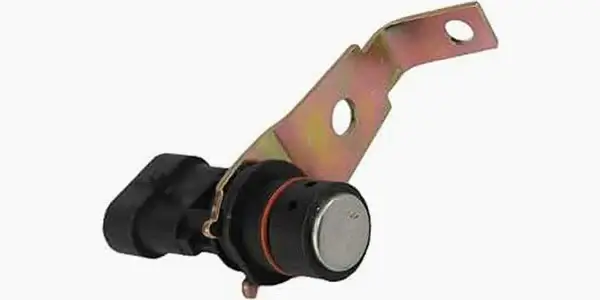
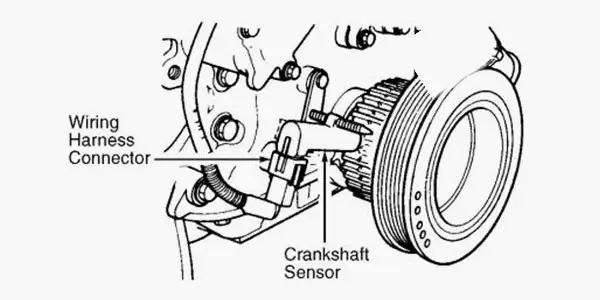
The crankshaft position sensor (CKP sensor) on the Ford 5.4L Triton V8 tells the engine computer (PCM) exactly where the crankshaft is in its rotation. This information is critical for ignition timing (when to fire the spark plugs) and fuel injection timing (when to pulse the injectors).
Unlike the GM Vortec CKP sensor (which is a 3-wire Hall Effect type), the Ford 5.4L CKP sensor is a 2-wire magnetic (variable reluctance) type. It generates its own AC voltage signal as the notched reluctor ring on the crankshaft passes by. It does not require external power, only a signal return path to the PCM.
If the CKP sensor fails, the PCM does not know when to fire the spark plugs or pulse the fuel injectors. The engine cranks but does not start. No spark, no fuel.
Symptoms of a Bad CKP Sensor (Ranked)
| Symptom | Frequency | Severity |
|---|---|---|
| Engine cranks but will not start | Very high | Critical |
| Intermittent stalling while driving | High | Critical |
| Check engine light (P0335, P0336, P0339) | High | Moderate |
| Erratic tachometer (RPM reads zero or jumps) | Medium | Moderate |
| Rough idle or misfire | Medium | Moderate |
| Engine hesitation or surging | Medium | Moderate |
| Reduced fuel economy | Low | Minor |
| Hard starting when engine is hot | Low | Moderate |
The most common pattern on the 5.4L: The engine starts fine when cold, then stalls or will not restart after warming up. This heat-related failure is the hallmark of a failing CKP sensor on the Ford 5.4L. The sensor works when cool but fails as engine heat soaks into it.
The tachometer test: When cranking the engine, watch the tachometer. If the RPM reading stays at zero while cranking, the CKP sensor is likely not producing a signal. A healthy CKP sensor will show 150-250 RPM while cranking.
What Causes CKP Sensor Failure?
| Cause | Likelihood | Notes |
|---|---|---|
| Heat damage | High | The 5.4L CKP sensor is behind the crankshaft pulley, exposed to engine heat |
| Oil contamination | Medium | Front main seal leaks can contaminate the sensor |
| Wiring harness damage | Medium | Wiring near the sensor is exposed to heat and road debris |
| Corroded electrical connector | Medium | The 2-pin connector can corrode over time |
| Internal sensor failure (age) | Low | Most sensors last 100,000+ miles |
| Damaged reluctor ring | Rare | The notched wheel on the crankshaft can be damaged |
How to Test the CKP Sensor with a Multimeter
The Ford 5.4L CKP sensor is a 2-wire magnetic type. Unlike the GM Hall Effect sensor, you can test it with an AC voltage measurement while cranking the engine.
Tools Needed
| Tool | Purpose | Cost |
|---|---|---|
| Digital multimeter with AC volts | Test sensor signal | $20-50 |
| Wire-piercing probe or back-probe | Access sensor wires | $10 |
| Helper (to crank engine) | Turn the key while you read the meter | Free |
Test Procedure
-
Locate the CKP sensor. It is behind the crankshaft pulley on the front of the engine. The 2-wire connector comes out of the timing cover.
-
Set your multimeter to AC volts (lowest AC range, usually 200mV or 2V).
-
Back-probe both sensor wires with the multimeter probes. The sensor must remain connected to its harness. Use a wire-piercing probe if you cannot back-probe the connector.
-
Have your helper crank the engine. The engine will not start (that is fine, you are just cranking it).
-
Watch the multimeter. A healthy CKP sensor will produce an AC voltage of 0.5V to 1.5V AC while cranking. The exact voltage varies by cranking speed and sensor condition.
Reading the Results
| Multimeter Reading | Diagnosis | Action |
|---|---|---|
| 0.5V to 1.5V AC while cranking | Sensor is working | Look elsewhere for the no-start cause |
| 0V (no signal) | Sensor has failed or wiring is broken | Check wiring, then replace sensor |
| Very low voltage (under 0.3V) | Sensor is weak or failing | Replace sensor |
| Intermittent signal | Sensor is failing intermittently | Replace sensor |
Check Wiring First
Before condemning the sensor, check the wiring:
- Inspect the 2-pin connector for corrosion, bent pins, or oil contamination. Clean with electrical contact cleaner if corroded.
- Check continuity. With the sensor disconnected, measure resistance across the two sensor terminals. A healthy magnetic CKP sensor reads 300-1,000 Ohms. If it reads open (infinite resistance), the sensor coil is broken and the sensor must be replaced.
- Check the wiring harness from the sensor to the PCM for chafing or damage.
How to Replace the CKP Sensor
The CKP sensor on the Ford 5.4L is located behind the crankshaft pulley. Access requires removing the crankshaft pulley bolt and pulling the pulley off.
Skill level: Intermediate to Advanced. Time: 1-3 hours.
Steps
-
Disconnect the negative battery terminal (10mm socket).
-
Remove the serpentine belt. Use a breaker bar on the belt tensioner to release tension and slip the belt off.
-
Remove the crankshaft pulley bolt. This is a large bolt (usually 21mm or 24mm) that is very tight. You need a breaker bar or impact wrench, and a way to hold the crankshaft from turning (a crankshaft locking tool or having a helper hold the flywheel with a screwdriver through the starter motor access).
-
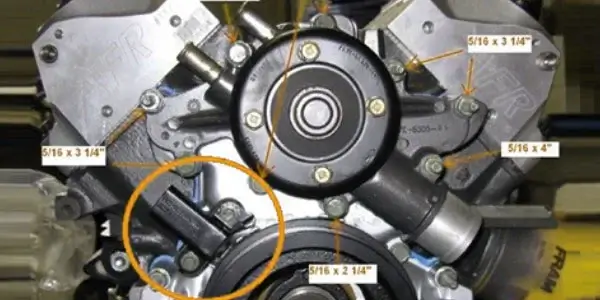
Remove the crankshaft pulley. Use a harmonic balancer puller ($20-40) to pull the pulley off the crankshaft. Do not use a regular gear puller, as it can damage the pulley.
-
Locate the CKP sensor behind the pulley, mounted in the timing cover.
-
Disconnect the electrical connector from the sensor.
-
Remove the mounting bolt (usually 10mm). Pull the sensor straight out.
-
Install the new sensor. Push it in until seated. Install and tighten the mounting bolt.
-
Reconnect the electrical connector.
-
Reinstall the crankshaft pulley and torque the bolt to spec (critical, usually 100-130 ft-lbs plus a specific angle depending on year).
-
Reinstall the serpentine belt.
-
Reconnect the battery.
-
Perform the relearn procedure (see next section).
Parts needed:
– CKP sensor (Motorcraft or quality aftermarket): $30-60
– Harmonic balancer puller: $20-40 (if you do not have one)
– 10mm socket, 21mm/24mm socket, breaker bar or impact wrench
After Replacement: Relearn Procedure
On Ford vehicles, after replacing the CKP sensor, you should perform a “Crankshaft Position System Variation Learn” procedure. Some Ford models support a manual relearn, others require a scanner.
Manual Relearn (Some Ford Models)
- Start the engine and let it reach operating temperature.
- Turn the engine off and wait 30 seconds.
- Restart and accelerate to 3,000 RPM, hold for 10 seconds, release.
- Repeat 2 more times.
- Let idle for 2 minutes.
- Drive at varying speeds for 10 minutes.
Scanner-Based Relearn
If the manual relearn does not clear the P0315 code, you need a bidirectional scanner. See our guide on what scanner can relearn a crankshaft position sensor for scanner recommendations.
Cost Breakdown: DIY vs Shop
| Service | DIY Cost | Shop Cost (US avg) | Time |
|---|---|---|---|
| CKP sensor replacement | $30-60 (part) | $190-280 | 1-3 hrs |
| CKP sensor test (multimeter) | $20-50 (multimeter) | $80-150 | 30 min |
| Harmonic balancer puller | $20-40 (tool) | included | – |
| Crankshaft relearn (scanner) | $200-500 (scanner) | $80-150 | 10-15 min |
| OBD2 code scan | $25-40 (scanner) | Free at parts stores | 5-15 min |
Total DIY cost: $50-100 (sensor + multimeter, if you have tools)
Total shop cost: $270-430 (diagnosis + sensor + relearn)
When to Call a Mechanic
Call a mechanic if:
– You do not have a harmonic balancer puller and cannot rent one (the crankshaft pulley cannot be removed without it)
– The crankshaft pulley bolt is seized and will not come loose (common on older vehicles in salt-belt states)
– After replacing the sensor, the engine still cranks but will not start (the problem may be the PCM, fuel pump, or ignition system, not the sensor)
– You do not have a bidirectional scanner for the relearn procedure
Frequently Asked Questions
Q: Will a bad crankshaft position sensor throw a code on a Ford 5.4L?
A: Sometimes. The most common codes are P0335 (circuit malfunction), P0336 (circuit range/performance), and P0339 (circuit intermittent). However, the Ford 5.4L PCM sometimes does not set a CKP code when the sensor fails completely. If the sensor produces no signal, the PCM may not detect it because it never receives a signal to evaluate. In that case, you need to test the sensor with a multimeter.
Q: Can I test the Ford 5.4L crankshaft position sensor with a multimeter?
A: Yes. Unlike the GM Vortec Hall Effect sensor, the Ford 5.4L CKP sensor is a magnetic (variable reluctance) type that generates its own AC voltage. Set your multimeter to AC volts, back-probe both sensor wires, and have someone crank the engine. A healthy sensor produces 0.5V to 1.5V AC while cranking. You can also check the sensor’s resistance with an Ohmmeter: a healthy sensor reads 300-1,000 Ohms across its two terminals.
Q: Why does my 5.4L start when cold but stall when hot?
A: This is the classic symptom of a failing CKP sensor on the Ford 5.4L. The sensor works when the engine is cool but fails as engine heat soaks into it. The sensor is located behind the crankshaft pulley, directly exposed to engine heat. As the sensor heats up, the internal coil resistance changes and the signal weakens or disappears. If your 5.4L starts fine cold but stalls or will not restart after warming up, the CKP sensor is the prime suspect.
Q: Where is the crankshaft position sensor on a Ford 5.4L?
A: The CKP sensor is behind the crankshaft pulley on the front of the engine, mounted in the timing cover. To access it, you must remove the serpentine belt, the crankshaft pulley bolt, and the crankshaft pulley itself using a harmonic balancer puller. The sensor is a 2-wire magnetic type with a single 10mm mounting bolt.
Q: Do I need to do a relearn after replacing the crankshaft position sensor on a Ford 5.4L?
A: Yes. After replacing the CKP sensor, perform a Crankshaft Position System Variation Learn procedure. Some Ford models support a manual relearn (accelerate to 3,000 RPM, release, repeat 3 times). If the manual relearn does not clear the P0315 code, you need a bidirectional scanner. See our guide on scanners for CPS relearn for details.
Q: How much does it cost to replace the crankshaft position sensor on a Ford 5.4L?
A: The sensor costs $30-60 for the part. At a shop, the total cost including labor is $190-280 because the crankshaft pulley must be removed to access the sensor. If you DIY, you also need a harmonic balancer puller ($20-40) and a large socket for the crankshaft pulley bolt. The job takes 1-3 hours depending on whether the pulley bolt is seized.
Sources & References
- Ford Motor Company – 5.4L Triton V8 Service Manual (Ford Service Information)
- Motorcraft – Crankshaft position sensor product specifications
- SAE J2012 – OBD-II Diagnostic Trouble Code definitions (P0335, P0336, P0339, P0315)
- NHTSA – Vehicle complaint database for Ford F-150 and Expedition (nhtsa.gov)
- RepairPal – Average repair cost estimates for Ford 5.4L crankshaft position sensor replacement
Related articles on CarsDailyHub:
– Car Problem Solver: Complete Symptom Guide
– 5.7 Vortec Crankshaft Position Sensor Symptoms: Causes, Diagnosis & Fix
– What Scanner Can Relearn a Crankshaft Position Sensor? Top 3 Picks
– How to Reset Crankshaft Position Sensor Without a Scanner
– What to Do After Replacing Crankshaft Sensor: Essential Steps