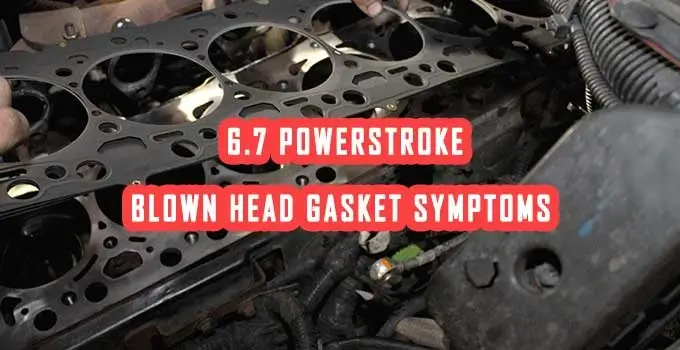
6.7 Powerstroke Blown Head Gasket Symptoms: How to Tell

By the CarsDailyHub Editorial Team | Automotive writers; every article fact-checked against OEM service documentation and owner-reported data | Updated June 2026
Quick Answer: The classic signs of a blown head gasket on a 6.7L Power Stroke are white smoke from the exhaust (burning coolant), unexplained coolant loss, overheating, bubbles or pressure in the coolant reservoir (combustion gases entering the cooling system), and oil and coolant mixing. The 6.7L is fairly robust on head gaskets from the factory, but heavy towing, hard tuning, or an overheating event can stretch the head bolts and lift a gasket. Confirm with a block (combustion gas) test before tearing into it.
This guide covers head gasket symptoms and diagnosis on the 6.7L Power Stroke diesel (Ford Super Duty, 2011 onward). Last reviewed: June 2026.
Table of Contents
- How a Head Gasket Fails on the 6.7
- The Main Symptoms
- What Causes It on the 6.7 Power Stroke
- How to Confirm It (Not Just Guess)
- What the Repair Involves
- Prevention
- Frequently Asked Questions
- Sources & References
How a Head Gasket Fails on the 6.7
The head gasket seals the combustion chambers, coolant passages, and oil passages between the cylinder heads and the block. On a diesel like the 6.7 Power Stroke, combustion pressures are very high, and the head is held down by torque-to-yield head bolts. When those bolts stretch, or the gasket is stressed by heat or pressure beyond its limit, the seal breaks down. Combustion gases can then leak into the cooling system, or coolant and oil can cross into places they should not be.
Importantly, the 6.7L uses bolts (not studs) from the factory, and under big power or sustained heavy loads those bolts can stretch, which is why head studs are a popular upgrade on heavily tuned trucks.
The Main Symptoms
| Symptom | What it indicates |
|---|---|
| White smoke from the exhaust | Coolant entering the combustion chamber and burning |
| Unexplained coolant loss | Coolant leaking internally with no visible puddle |
| Overheating | Lost cooling efficiency or combustion gases in the coolant |
| Bubbles / pressure in coolant tank | Combustion gases pushing into the cooling system |
| Coolant in the oil (milky oil) | Internal cross-leak between coolant and oil |
| Oil in the coolant | The reverse cross-leak |
| Rough running, lost power | Compression loss between cylinders |
| Coolant smell or sweet exhaust | Burning coolant |
A single mild symptom is not proof, but several of these together strongly point to a head gasket or related sealing failure.
What Causes It on the 6.7 Power Stroke
- Overheating events: The most common trigger, a cooling failure (water pump, thermostat, plugged cooler, low coolant) that lets the engine run hot and stress the gasket.
- Aggressive tuning and high power: More cylinder pressure than the factory head bolts were designed to clamp, which can lift a head, hence the head-stud upgrade.
- Sustained heavy towing in heat: Prolonged high loads raise temperatures and pressures.
- Age and high mileage: Gaskets and bolts fatigue over time.
- Related cooling-system neglect: Old coolant and clogged coolers raise the risk.
How to Confirm It (Not Just Guess)
Because head gasket repair is expensive, confirm before committing:
- Block test (combustion leak test): A chemical test on the coolant detects combustion gases in the cooling system, the most telling check for a breached gasket.
- Cooling-system pressure test: Looks for pressure loss and where coolant is going.
- Inspect the oil and coolant: Milky oil or oil in the coolant indicates a cross-leak.
- Watch the coolant reservoir with the engine running for persistent bubbling.
- Scan for codes and check coolant temperature behavior.
- Rule out look-alikes (see the related article on what gets mistaken for a blown head gasket), other faults can mimic these symptoms.
A confirmed combustion-gas test plus coolant loss is far more reliable than acting on white smoke alone.
What the Repair Involves
Head gasket repair on the 6.7 Power Stroke is a major job: the cab is typically lifted off the frame for access, the heads come off, the surfaces are inspected and machined as needed, and new gaskets are installed. Many owners take the opportunity to install head studs in place of the factory bolts for better long-term clamping, especially on tuned or hard-working trucks.
This is not a driveway job for most owners, it is labor-intensive and requires careful torque procedures. Get a confirmed diagnosis and a reputable diesel shop, and address the root cause (cooling, tuning) so it does not happen again.
Prevention
- Keep the cooling system healthy: fresh coolant, a working thermostat and water pump, and clean coolers.
- Never ignore an overheating event; stop and address it before damage occurs.
- Be realistic with tuning; big power without head studs raises the risk.
- Service on schedule and watch coolant level and oil condition.
Most 6.7L head gasket failures trace back to heat or pressure beyond design limits, both of which are largely preventable.
Frequently Asked Questions
Q: What are the first signs of a blown head gasket on a 6.7 Power Stroke?
A: Early signs are often unexplained coolant loss with no visible leak, the coolant reservoir bubbling or building pressure with the engine running, and intermittent overheating. White exhaust smoke that smells sweet (burning coolant) and milky oil are stronger indicators. Several of these together point to a head gasket, which you should confirm with a combustion-gas (block) test.
Q: Is the 6.7 Power Stroke prone to head gasket failure?
A: From the factory it is reasonably robust, but it uses head bolts rather than studs, and under aggressive tuning, sustained heavy towing, or after an overheating event those bolts can stretch and lift a head gasket. Stock, well-maintained trucks are much less likely to have a problem than heavily tuned ones, which is why head studs are a common upgrade.
Q: Can I drive my 6.7 with a blown head gasket?
A: You should not. Continuing to drive risks severe overheating, coolant getting into the oil (which destroys bearings), and warping or cracking the heads, turning a gasket job into a much bigger repair. If you suspect a head gasket and see overheating or coolant loss, stop driving and have it diagnosed and repaired.
Q: How do I know it’s the head gasket and not something else?
A: Confirm rather than guess. A block test detects combustion gases in the coolant, a cooling-system pressure test finds where coolant is going, and inspecting the oil and coolant reveals cross-leaks. Several symptoms can be mimicked by other faults like a bad EGR cooler or oil cooler, so a proper diagnosis prevents an unnecessary head gasket repair.
Q: Should I install head studs when fixing the head gasket?
A: Many owners do, especially on tuned or hard-working trucks, because head studs clamp the heads more securely than the factory bolts and reduce the chance of a repeat failure. Since the engine is already apart for the gasket job, it is a sensible time to upgrade. Discuss it with your diesel shop based on how you use the truck.
Sources & References
- Ford and Power Stroke service information for the 6.7L diesel
- Diesel industry guidance on head gasket diagnosis (combustion-gas testing) and head studs
- NHTSA complaint database for Ford Super Duty (nhtsa.gov)
- Owner-reported reliability and repair data
Related articles on CarsDailyHub:
– Car Problem Solver: Complete Symptom Guide
– What Can Be Mistaken for a Blown Head Gasket
– Stuck Closed Thermostat Symptoms and Fix
– Does a Bad Water Pump Make Noise?