Should I Change Transmission Fluid After 100k Miles?

By the CarsDailyHub Editorial Team | Automotive writers; every article fact-checked against OEM service documentation | Updated June 2026
Quick Answer: Yes, you should change your transmission fluid after 100,000 miles, but with caution. If the fluid has never been changed and is dark or burnt, a full flush can dislodge debris and cause problems. In that case, do a drain-and-fill (not a flush) which replaces 40-50% of the fluid and is gentler on an old transmission. If the fluid is still relatively clean and red, a full flush is safe. The risk of NOT changing the fluid (transmission failure from degraded fluid) is greater than the risk of changing it.
This guide covers transmission fluid service decisions for high-mileage vehicles. Last reviewed: June 2026.
Table of Contents
- The Debate: Change vs Not Change at 100k+
- Drain-and-Fill vs Full Flush
- How to Check Your Fluid Condition
- What Happens If You Never Change the Fluid?
- What Happens If You Flush a Neglected Transmission?
- Recommended Approach by Mileage
- Cost Breakdown
- Frequently Asked Questions
- Sources & References
The Debate: Change vs Not Change at 100k+
The question of whether to change transmission fluid at high mileage is one of the most debated topics in automotive maintenance. Here is the honest, balanced answer:
The case for changing:
– Transmission fluid degrades over time and mileage. It loses its lubricating properties, friction modifiers break down, and it accumulates metal particles and clutch material.
– Degraded fluid causes shudder, harsh shifting, and accelerated wear.
– Fresh fluid restores proper lubrication and shifting quality.
– Most manufacturers specify fluid changes at 60,000-100,000 miles.
The case against changing (the “if it ain’t broke” argument):
– If the fluid has never been changed in 100,000+ miles, the friction material suspended in the old fluid may actually be helping the clutches grip. New fluid with fresh friction modifiers can cause the clutches to slip.
– A full flush with a machine can dislodge debris that was settled in the pan and valve body, sending it into narrow passages and causing shifting problems.
– Some mechanics have seen transmissions fail shortly after a first-time flush at high mileage.
The balanced answer: Change the fluid, but use a drain-and-fill (not a flush) if the fluid is old and dark. A drain-and-fill replaces 40-50% of the fluid and is much gentler. You can do another drain-and-fill in 15,000-30,000 miles to gradually refresh the fluid without shocking the transmission.
Drain-and-Fill vs Full Flush
| Method | Fluid Replaced | Risk Level | Best For |
|---|---|---|---|
| Drain-and-fill | 40-50% | Very low | High-mileage, never-serviced transmissions |
| Full flush (machine) | 90-100% | Medium | Transmissions with relatively clean fluid |
| Full flush + filter | 90-100% + new filter | Low | Best overall, but more expensive |
| Drop pan + change filter + refill | 60-70% + new filter | Low | Best for high-mileage service |
Recommendation for 100k+ mile transmissions that have never been serviced:
1. Do a drain-and-fill first ($80-150 at a shop).
2. Drive for 15,000-30,000 miles.
3. Do another drain-and-fill.
4. Repeat once more. After 3 drain-and-fills, most of the old fluid has been replaced gradually.
This approach avoids the risk of a full flush dislodging debris while still refreshing the fluid over time.
How to Check Your Fluid Condition
- Warm the transmission by driving for 15-20 minutes.
- Park on level ground with the engine running.
- Pull the transmission dipstick (if equipped).
- Check color and smell:
| Fluid Color | Condition | Recommendation |
|---|---|---|
| Red/pink and clear | Good | Change at normal interval |
| Dark red/brown | Degraded | Change soon (drain-and-fill) |
| Dark brown/black | Severely degraded | Drain-and-fill, do not flush |
| Burnt smell | Overheated | Drain-and-fill, inspect for damage |
| Milky/pink milkshake | Coolant contamination | Tow to shop immediately |
What Happens If You Never Change the Fluid?
If you never change the transmission fluid:
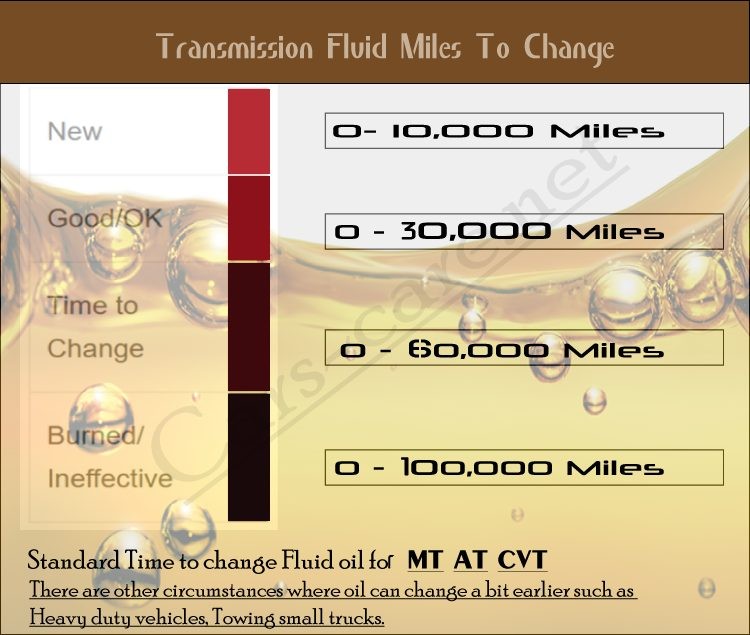
– 30,000-60,000 miles: Fluid begins to degrade, shifting may become slightly harsher.
– 60,000-100,000 miles: Fluid is dark and has lost most of its friction modifiers. Shudder may begin. Metal particles accumulate.
– 100,000-150,000 miles: Clutch packs wear faster from degraded fluid. Valve body passages may clog with debris. Shudder and harsh shifting become noticeable.
– 150,000+ miles: Transmission failure becomes increasingly likely. The fluid can no longer protect the internal components.
The risk of not changing is greater than the risk of changing. A transmission that never gets fluid changes will fail. A transmission that gets gentle drain-and-fills at high mileage has a much better chance of surviving.
What Happens If You Flush a Neglected Transmission?
The horror stories you hear about transmissions failing after a flush are real but rare. Here is what can happen:
-
Debris dislodging: A pressurized flush machine can dislodge clutch material and metal particles that were settled in the pan and valve body. This debris can lodge in narrow solenoid passages, causing shifting problems.
-
Friction modifier shock: Old fluid has worn-out friction modifiers. The clutches have adapted to this degraded fluid. Fresh fluid with new friction modifiers can change the clutch friction characteristics, causing slipping.
-
Seal damage: Old, hardened seals may be holding together with varnish deposits. Fresh fluid with detergents can dissolve the varnish, causing the seals to start leaking.
These risks are primarily associated with full machine flushes on transmissions with very old, dark, never-changed fluid. A drain-and-fill does not have these risks because it does not pressurize the system and only replaces part of the fluid.
Recommended Approach by Mileage
| Mileage | Fluid Condition | Recommended Service | Cost |
|---|---|---|---|
| Under 60,000 | Any | Full flush or drain-and-fill | $80-250 |
| 60,000-100,000 | Red/pink | Full flush | $150-250 |
| 60,000-100,000 | Brown | Drain-and-fill | $80-150 |
| 100,000-150,000 | Never changed, dark | Drain-and-fill, repeat in 15k-30k | $80-150 each |
| 100,000-150,000 | Changed regularly, still red | Full flush | $150-250 |
| 150,000+ | Never changed, dark | Drain-and-fill, but consider selling | $80-150 |
| Any mileage | Burnt smell | Drain-and-fill + inspect | $80-250 |
| Any mileage | Milky | Tow to shop, do not drive | $500+ |
Cost Breakdown
| Service | DIY Cost | Shop Cost (US avg) | Time |
|---|---|---|---|
| Drain-and-fill | $30-60 (fluid) | $80-150 | 30-45 min |
| Full flush (machine) | $60-100 (fluid) | $150-250 | 45-60 min |
| Drop pan + filter + refill | $50-80 (fluid + filter) | $150-300 | 1-2 hrs |
| Full flush + filter | $80-120 (fluid + filter) | $200-400 | 1.5-2.5 hrs |
Frequently Asked Questions
Q: Should I change my transmission fluid at 100,000 miles?
A: Yes, but use a drain-and-fill, not a full flush, if the fluid has never been changed. A drain-and-fill replaces 40-50% of the fluid and is much gentler on an old transmission. You can do another drain-and-fill in 15,000-30,000 miles to gradually refresh the fluid. The risk of not changing the fluid (transmission failure) is greater than the risk of a gentle drain-and-fill.
Q: Can changing transmission fluid cause transmission failure?
A: A full machine flush on a transmission with very old, dark, never-changed fluid can dislodge debris and cause shifting problems. This is rare but real. To avoid this risk, use a drain-and-fill instead of a flush. A drain-and-fill does not pressurize the system and only replaces part of the fluid, making it much safer for high-mileage transmissions.
Q: What is the difference between a transmission flush and a drain-and-fill?
A: A flush uses a machine to pump new fluid through the transmission while removing old fluid, replacing 90-100% of the fluid. A drain-and-fill simply removes the drain plug, lets the fluid drain out by gravity (40-50% of total fluid), and refills. The drain-and-fill is gentler and safer for high-mileage transmissions. The flush is more thorough but riskier on neglected transmissions.
Q: What happens if I never change my transmission fluid?
A: The fluid degrades over time, losing its lubricating and friction-modifying properties. Metal particles and clutch material accumulate. Shudder, harsh shifting, and eventually transmission failure will occur. Most transmissions that never get fluid changes fail between 100,000-150,000 miles. Transmissions that get regular fluid changes can last 200,000+ miles.
Q: How often should I change my transmission fluid?
A: Most manufacturers recommend every 60,000-100,000 miles for normal driving. For severe service (towing, city driving, extreme temperatures), every 30,000-45,000 miles. CVT transmissions (Nissan, Honda) should be changed every 30,000-45,000 miles regardless of the manufacturer’s “lifetime fluid” claim. Always use the fluid specified by the manufacturer.
Q: Is it too late to change my transmission fluid at 150,000 miles?
A: It is not too late, but be realistic. If the transmission is already slipping or shuddering, a fluid change will not fix internal damage. If the transmission is still working fine but the fluid is old, a drain-and-fill can extend its life. Do not do a full flush at 150,000 miles on never-serviced fluid. Use drain-and-fill and repeat every 15,000-30,000 miles.
Sources & References
- OEM service manuals (GM, Ford, Toyota, Honda, Nissan) – Transmission fluid service intervals
- ATF manufacturer specifications (Dexron, Mercon, NS-2, NS-3, HCF-2)
- SAE – Automatic transmission fluid standards
- RepairPal – Average transmission service cost estimates
- ASE – Transmission service best practices
Related articles on CarsDailyHub:
– Transmission & Drivetrain: How to Diagnose Any Transmission Problem
– How Much Transmission Fluid Does a 4L60E Hold?
– Can I Use Transmission Fluid for Power Steering Fluid?
– Chevy Colorado Transmission Problems: Causes, Symptoms & Fix
– Nissan Rogue CVT Transmission Problems: Causes, Symptoms & Fix