Toyota C1201 Code: Causes, Symptoms & How to Fix It

By the CarsDailyHub Editorial Team | Automotive writers; every article fact-checked against Toyota’s owner’s manual and OEM service documentation | Updated June 2026
Quick Answer: The C1201 code on a Toyota means “Engine Control System Malfunction.” It is almost always a secondary code that appears alongside a primary engine code (like P0455 or P0441). The engine computer detects a fault, then disables traction and stability control as a precaution, which sets C1201. Fix the primary engine code and C1201 clears itself. The most common cause is a loose fuel cap. Average repair cost: $0 to $25 for a fuel cap, up to $300 for a purge valve.
This guide covers the C1201 diagnostic trouble code on Toyota vehicles including Camry, Corolla, RAV4, Tacoma, Prius, Sienna, 4Runner, and Highlander. Specifications reference Toyota’s owner’s manual and OEM service documentation. Last reviewed: June 2026.
Table of Contents
- What Does the C1201 Code Mean?
- Symptoms You Will Notice With C1201
- What Causes the C1201 Code?
- How to Diagnose C1201 Step by Step
- How to Fix the C1201 Code
- Toyota Model-Specific Notes
- Will C1201 Damage Your Engine If Ignored?
- How to Reset C1201 After Repair
- Cost Breakdown: DIY vs Shop
- Frequently Asked Questions
- Sources & References
What Does the C1201 Code Mean?
C1201 is defined as “Engine Control System Malfunction” in Toyota’s diagnostic code system. It is a chassis code (the “C” prefix indicates chassis, not powertrain), but it is triggered by the engine control module (ECM).
Here is the key thing to understand: C1201 is almost never the root cause. It is a secondary code. Here is how it works:
- The engine computer detects a fault (like a loose fuel cap, a bad oxygen sensor, or a misfire).
- The engine computer sets a primary code (like P0455, P0441, or P0300).
- Because the engine has a fault, the engine computer tells the traction and stability control systems to shut down as a safety precaution.
- The traction control system sets C1201 to record that it was disabled by the engine computer.
So when you scan your codes and see C1201, you need to look for the primary P-code that caused it. Fix the P-code and C1201 clears itself.
If you only see C1201 and no P-codes, the primary code may have been intermittent and cleared itself, but C1201 remains stored. Clear all codes with a scanner and see if C1201 returns on the next drive cycle.
Symptoms You Will Notice With C1201
When C1201 is set, you will typically see:
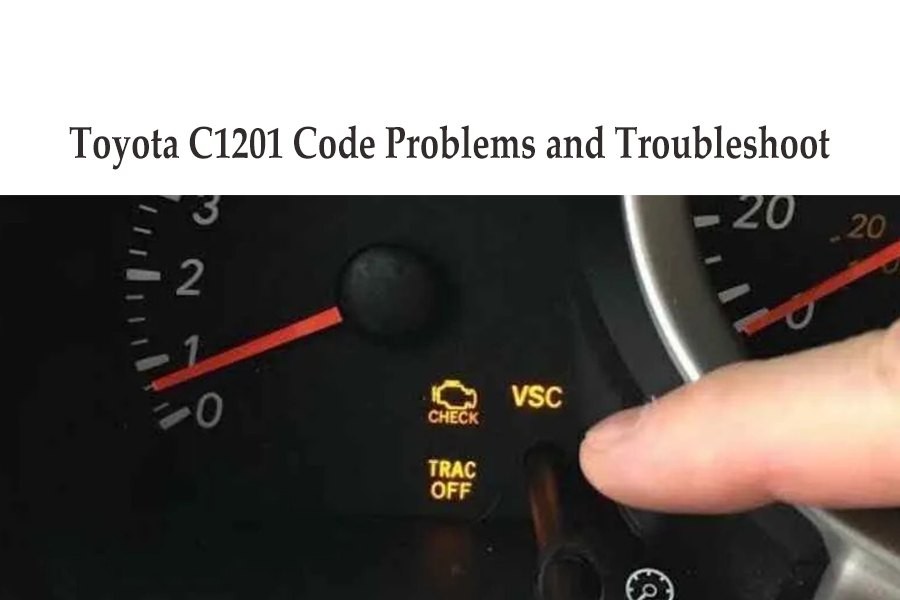
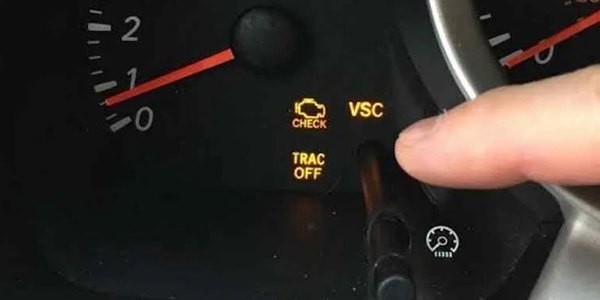
- Check engine light (amber, steady or flashing)
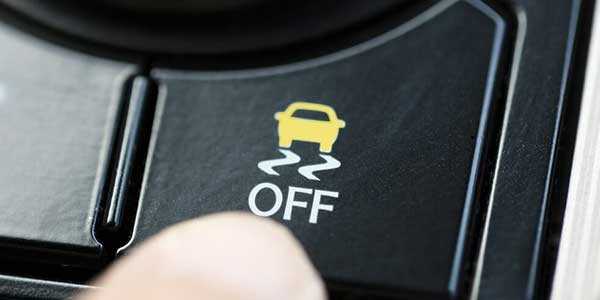
- TRAC OFF light illuminated
- VSC OFF light illuminated (on some models)
- Reduced engine power or limp mode (in some cases)
- Difficulty starting the vehicle (rare, only if the primary cause is severe)
- Decreased fuel efficiency (if the primary cause is an oxygen sensor or fuel system issue)
- Unusual engine noises or vibrations (if the primary cause is a misfire)
- Stalling or hesitation while driving (if the primary cause is severe)
The three-light combination (check engine + TRAC OFF + VSC OFF) is the most common symptom. If you see all three, C1201 is almost certainly stored alongside a primary engine code.
What Causes the C1201 Code?
C1201 is caused by any engine fault that triggers a check engine code. The engine computer disables traction control whenever the engine has a fault, and C1201 records that action. Here are the most common primary causes, ranked by likelihood:
| Primary Code | Cause | Likelihood | Fix Difficulty |
|---|---|---|---|
| P0455 | EVAP large leak (loose fuel cap) | Very high | Easy (tighten or replace cap) |
| P0441 | EVAP incorrect purge flow | High | Easy to Medium (cap or purge valve) |
| P0171 | System too lean (vacuum leak, dirty MAF) | Medium | Medium |
| P0300 | Random misfire (spark plugs, coils, fuel) | Medium | Medium |
| P0420 | Catalyst efficiency below threshold | Low | Hard (verify before replacing) |
| P0505 | Idle air control system | Low | Medium |
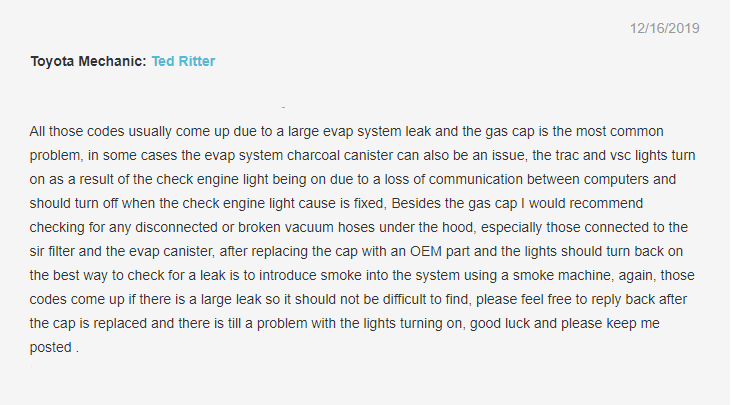
The fuel cap is the single most common cause. A loose, cracked, or worn fuel cap creates a vapor leak in the evaporative emissions system. The computer sees this as a “large leak” (P0455) or “incorrect purge flow” (P0441), sets the check engine code, disables traction control, and C1201 follows.
How to Diagnose C1201 Step by Step
Tools You Need
| Tool | Purpose | Cost |
|---|---|---|
| OBD2 scanner | Read and clear codes | $25-40 (basic), $80-150 (advanced) |
| Flashlight | Inspect fuel cap and wiring | $5 |
| Multimeter | Test sensors and wiring (optional) | $20-50 |
Step by Step
-
Read all stored codes. Plug in your OBD2 scanner and read every code, not just C1201. You need to find the primary P-code that caused C1201. Write down all codes.
-
If P0455 or P0441 is present: Start with the fuel cap. Remove it, inspect the rubber O-ring seal for cracks or hardening, and reinstall it until it clicks at least once. Clear the codes and drive for 1-3 days. If the codes do not return, the fuel cap was the problem.
-
If P0171 is present: Check for vacuum leaks. Listen for hissing around the intake manifold and vacuum hoses. Inspect the air filter and clean the MAF sensor with MAF cleaner spray ($10).
-
If P0300 or P0301-P0306 is present: The engine is misfiring. Check spark plugs (gap and condition), ignition coils (swap coils between cylinders to see if the misfire follows), and fuel quality.
-
If P0420 is present: The catalytic converter may be failing, but verify before replacing. A failing oxygen sensor can mimic P0420. Test the O2 sensors first.
-
If only C1201 is present (no P-codes): The primary code was intermittent. Clear C1201 with the scanner and drive normally. If C1201 returns, scan again immediately to catch the primary code before it clears.
-
Check the brake light switch. A faulty brake light switch can trigger C1201 on some Toyota models. Have someone stand behind the vehicle while you press the brake pedal. If the brake lights do not illuminate, the brake light switch may be faulty ($15-30 part, 30 minutes to replace).
How to Fix the C1201 Code
Fix 1: The Fuel Cap (Most Common)
- Remove the fuel cap and inspect the rubber O-ring seal.
- If the seal is cracked, hardened, or flattened, replace the cap. A genuine Toyota cap (part number varies by model, typically $15-25) is worth the few extra dollars over aftermarket.
- If the seal looks fine, reinstall the cap and tighten until it clicks at least once.
- Clear the codes with a scanner.
- Drive for 1-3 days. If the codes do not return, the fuel cap was the problem.
Cost: $0 (tighten) to $25 (new cap). Time: 2 minutes. Tools: none.
Fix 2: The Purge Valve (If the Cap Does Not Fix It)
If a new fuel cap does not clear P0455 or P0441, the purge valve (EVAP canister purge solenoid) may be stuck open or closed.
- Disconnect the negative battery terminal (10mm socket).
- Locate the purge valve (follow the rubber hose from the intake manifold toward the firewall or canister).
- Disconnect the electrical connector and remove the two hose clamps.
- Replace the valve with a genuine Toyota part ($40-80).
- Reconnect everything and clear the codes.
Cost: $40-80 (part) DIY; $150-250 at a shop. Time: 30-45 min. Tools: 10mm socket, pliers, flathead screwdriver.
Fix 3: Brake Light Switch (If Brake Lights Are Not Working)
- Locate the brake light switch above the brake pedal.
- Disconnect the electrical connector.
- Remove the switch (usually a quarter-turn or clip release).
- Install the new switch ($15-30).
- Reconnect and test brake lights.
Cost: $15-30 (part) DIY; $80-120 at a shop. Time: 20-30 min. Tools: pliers, flathead screwdriver.
Fix 4: Other Primary Codes
If the primary code is not EVAP-related (P0171, P0300, P0420, etc.), the fix depends on the specific code. See our related articles for detailed diagnosis guides on each code.
Toyota Model-Specific Notes
The C1201 code appears across the Toyota lineup, but some models have specific patterns:
Toyota Camry (2007-2017): C1201 commonly appears with P0455 due to a known EVAP purge valve issue. Toyota issued a technical service bulletin for the purge valve on some model years. If your Camry has under 80,000 miles, check with a dealer whether the purge valve is covered under extended warranty.
Toyota Tacoma (2005-2015): C1201 with P0455 is extremely common on Tacomas. The fuel cap is the usual culprit, but the charcoal canister can also crack on older models, requiring replacement ($150-300).
Toyota Prius (2010-2015): C1201 can appear alongside hybrid system codes. If you see C1201 with a hybrid system warning, the issue may be in the hybrid powertrain, not the EVAP system. Have a hybrid-qualified shop diagnose.
Toyota RAV4 (2013-2018): C1201 with P0171 is common on RAV4s with the 2.5L engine. The usual cause is a dirty MAF sensor or a small vacuum leak in the PCV hose. Clean the MAF sensor first ($10 for cleaner) before replacing parts.
Toyota Sienna (2011-2020): C1201 with P0455 is common. The fuel cap is the usual cause, but the canister vent valve can also fail on models driven in dusty conditions.
Will C1201 Damage Your Engine If Ignored?
C1201 itself does not damage the engine. It is a notification code that traction control has been disabled. However, the primary code that caused C1201 can cause damage if ignored:
- P0455/P0441 (EVAP leak): Will not damage the engine, but will cause you to fail an emissions test and may reduce fuel efficiency slightly.
- P0300 (misfire): Can damage the catalytic converter if ignored. A flashing check engine light means active misfire. Get to a shop the same day.
- P0171 (lean condition): Can cause rough running and, over time, valve damage if the cause is a severe vacuum leak.
- P0420 (catalyst): Will not damage the engine, but indicates the catalytic converter is failing. You will fail an emissions test.
Safe to drive with C1201? Yes, with caution. Traction and stability control are disabled, so avoid wet roads, aggressive cornering, and off-road use. Get the primary code diagnosed within a week.
How to Reset C1201 After Repair
Once you have fixed the primary code:
Method 1, OBD2 scanner (preferred):
Plug in your scanner, navigate to “Clear Codes” or “Erase Codes,” and confirm. All codes clear immediately, including C1201, the primary P-code, and the TRAC OFF and VSC OFF lights.
Method 2, Battery disconnect (no scanner):
1. Turn off the engine and all electrics.
2. Disconnect the negative (black) battery terminal with a 10mm socket.
3. Wait 3-5 minutes for the ECM capacitors to discharge.
4. Reconnect the negative terminal and tighten.
5. Start the engine. The lights should be off. If they return, the problem is not fixed.
Important: Disconnecting the battery resets radio presets, clock, and idle/fuel-trim adaptations. The engine may idle slightly rough for the first 10-20 minutes as the computer relearns. This is normal.
Cost Breakdown: DIY vs Shop
| Fix | DIY Cost | Shop Cost (US avg) | Time |
|---|---|---|---|
| Tighten fuel cap | $0 | $0 | 2 min |
| Replace fuel cap (genuine Toyota) | $15-25 | $25-60 | 2 min |
| Replace purge valve | $40-80 (part) | $150-250 | 30-45 min |
| Replace brake light switch | $15-30 (part) | $80-120 | 20-30 min |
| Clean MAF sensor | $10 (cleaner) | $50-80 | 15 min |
| EVAP smoke-test diagnosis | – | $80-150 | 30-60 min |
| OBD2 code scan | $25-40 (scanner) | Free at parts stores; $80-150 at shop | 5-15 min |
When to call a mechanic instead of DIY:
– If the primary code is P0420 (catalyst), do not replace the catalytic converter without proper diagnosis. A failing O2 sensor mimics P0420 and costs $120, not $900.
– If the primary code is a misfire (P0300) and you are not comfortable swapping ignition coils, have a shop diagnose.
– If you see C1201 alongside a hybrid system warning on a Prius, do not DIY. Hybrid systems involve high-voltage components.
Frequently Asked Questions
Q: Is it safe to drive with the C1201 code?
A: Yes, with caution. The vehicle is drivable, but traction and stability control are disabled. Avoid wet roads, aggressive cornering, and off-road use until it is fixed. The underlying engine issue is usually minor (a fuel cap or purge valve), but you will not know for certain until you read the primary code. If the check engine light is flashing, that means an active misfire. Reduce speed and get to a shop immediately.
Q: Will the C1201 code clear itself?
A: Not always. The primary P-code may self-clear after a few drive cycles if the computer confirms the fix, but C1201 often requires a manual code clear with a scanner or a battery disconnect. Clearing the codes after the fix is the reliable way to reset everything.
Q: I tightened my gas cap and the code is still on, does that mean the cap was not the problem?
A: Not necessarily. The computer runs the EVAP self-test on a specific drive cycle, usually after the fuel level drops below a certain point and the engine is fully warmed up. It can take 1-3 days of normal driving for the test to run and the code to clear. If the code is still on after a week with a properly tightened or new cap, the leak is elsewhere. Most likely the purge valve or a cracked EVAP hose.
Q: Can a bad battery cause the C1201 code?
A: Yes, indirectly. A weak battery causes low voltage during cranking, which can cause sensors to report erroneous readings and trigger random codes. If you are seeing multiple unrelated codes or the lights flicker during startup, test the battery first. A healthy battery should read 12.6V at rest and not drop below 9.6V during cranking.
Q: How much does it cost to fix the C1201 code?
A: It depends entirely on the primary code. The most common fix, a fuel cap, costs $0 to $25. A purge valve runs $40-80 in parts. A brake light switch is $15-30. The expensive outlier is a catalytic converter (P0420), which can run $800-1,200, but always diagnose before replacing. Always read the primary code before estimating cost.
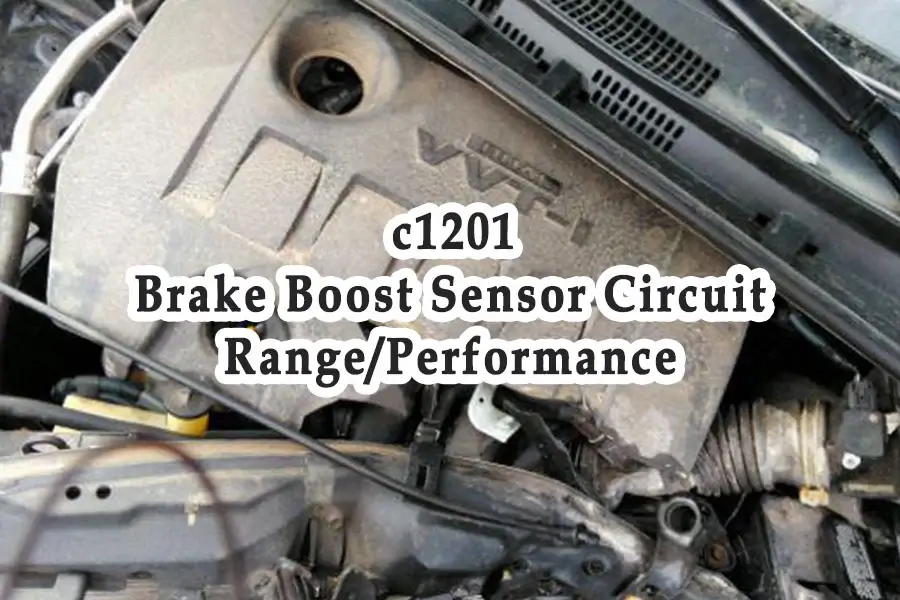
Q: Does the C1201 code mean my brake boost sensor is bad?
A: Not usually. C1201 is defined as “Engine Control System Malfunction” and is almost always caused by an engine fault that disables traction control. A separate code, C1201 on some specific Toyota models can also relate to the brake boost sensor circuit, but this is less common. If your scanner shows C1201 alongside P-codes, the engine fault is the cause. If C1201 appears alone with brake-related symptoms, have the brake boost sensor diagnosed separately.
Sources & References
- Toyota Motor Corporation – Toyota Owner’s Manuals (model-year specific; available at toyota.com/owners)
- Toyota Technical Service Bulletins covering EVAP purge valve and brake light switch (VIN-specific; available through Toyota dealers)
- SAE J2012 – OBD-II Diagnostic Trouble Code definitions (C1201, P0455, P0441, P0171, P0300, P0420)
- NHTSA – Vehicle complaint database for Toyota by model year (nhtsa.gov)
- RepairPal – Average repair cost estimates for Toyota by repair type
Related articles on CarsDailyHub:
– OBD Codes & Diagnostics: How to Read and Fix Any OBD Error Code
– Trac Off & Check Engine Light on Toyota Tacoma: Causes, Codes & Fix
– Toyota Dashboard Warning Lights: What Every Symbol Means
– How to Fix Check VSC System Toyota Camry
– OBD2 Diagnostic App: How to Use a Code Scanner