2010 Ford Escape Dash Lights and What They Mean

By the CarsDailyHub Editorial Team | Automotive writers; every article fact-checked against Ford’s owner’s manual and OEM service documentation | Updated June 2026
Quick Answer: On a 2010 Ford Escape, the dash lights that mean stop driving now are the red engine coolant temperature light, the red oil pressure light, the red battery (charging) light, and the red brake warning light. The amber wrench (powertrain) light usually means the throttle body has put the Escape into reduced-power limp mode, a very common 2010 Escape issue. A flashing check engine light is an active misfire, treat it like a red light.
This guide covers the 2010 Ford Escape (second generation, 2008-2012), with its 2.5L four-cylinder and 3.0L V6 engines. Specifications reference Ford’s owner’s manual and OEM service documentation. Last reviewed: June 2026.
Table of Contents
- How 2010 Ford Escape Dash Lights Work (Color Logic)
- Complete 2010 Ford Escape Warning Light Table
- Red Warning Lights, Stop Driving Immediately
- Amber/Yellow Warning Lights, Diagnose Soon
- Known 2010 Escape Issues That Trigger Lights
- Green & Blue Indicator Lights (Informational)
- What to Do When a Light Comes On (Decision Flow)
- How Much It Costs to Diagnose
- Frequently Asked Questions
- Sources & References
How 2010 Ford Escape Dash Lights Work (Color Logic)
The 2010 Escape uses Ford’s three-tier colour system:
- Red = danger. A system is failing or about to cause damage. Pull over safely and stop the engine.
- Amber/Yellow = caution. The vehicle is still drivable but needs attention soon.
- Green/Blue = informational. A feature is on, such as headlights or cruise. No action needed.
The 2010 Escape has one symbol that trips owners up: the amber wrench. On a Ford, the wrench is the powertrain malfunction light, not a “service due” reminder. On this generation it most often means the electronic throttle body has faulted and the Escape has entered reduced-power “limp mode.” A flashing check engine light, by contrast, means an active misfire, get to a shop the same day.
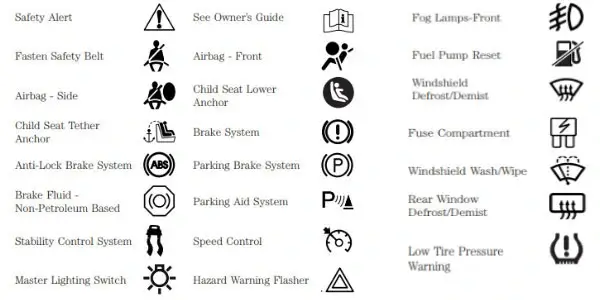
Complete 2010 Ford Escape Warning Light Table
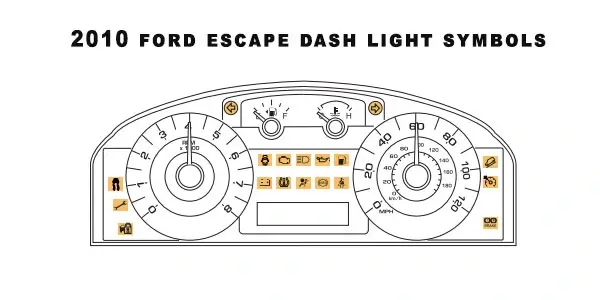
| Symbol | Name | Color | Severity | What It Means | Action |
|---|---|---|---|---|---|
| Thermometer in liquid | Engine Coolant Temp | Red | Stop now | Engine overheating | Pull over, stop, let cool 20+ min |
| Oil can with drip | Oil Pressure | Red | Stop now | Low oil pressure | Stop, check oil, do not restart if low |
| Battery | Charging System | Red | Stop now | Alternator not charging | Reduce load, drive to shop now |
| (!) in circle / BRAKE | Brake System | Red | Stop now | Parking brake, low fluid, or fault | Release brake; check fluid; tow if needed |
| Wrench | Powertrain Malfunction | Amber | Diagnose soon | Throttle body / powertrain fault, limp mode | Reduce power, drive to shop, scan codes |
| Engine outline | Check Engine | Amber | Diagnose soon | Emissions/powertrain fault | Tighten gas cap first; scan if it stays on |
| Engine outline flashing | Active Misfire | Amber flashing | Stop now | Misfire damaging catalytic converter | Reduce speed and load, shop today |
| Steering wheel with (!) | Power Steering (EPAS) | Amber | Diagnose soon | Electric power steering fault | Steering may go heavy; diagnose soon |
| Sliding car | AdvanceTrac / Stability | Amber | Diagnose soon | Stability/traction fault or active | Steady = scan; brief flash = normal |
| ABS in circle | Anti-Lock Brakes | Amber | Diagnose soon | ABS disabled, base brakes work | Drive carefully, get it checked |
| Tire with (!) | Tire Pressure (TPMS) | Amber | Check soon | One or more tires low | Inflate to door-jamb spec |
| Person with airbag | SRS Airbag | Amber | Diagnose soon | Airbag fault | Get it diagnosed |
| Fuel pump | Low Fuel | Amber | Refuel soon | Low fuel level | Refuel soon |
| 4×4 / AWD | Four/All-Wheel Drive | Amber | Diagnose soon | 4WD/AWD system fault | Have the system checked |
| Headlight beams | Low Beam | Green | Info | Headlights on | Normal |
| Headlight with lines | High Beams | Blue | Info | High beams on | Dim for oncoming traffic |
| Arrows | Turn Signal | Green | Info | Signal active | Normal |
Red Warning Lights, Stop Driving Immediately
Engine Coolant Temperature
The red thermometer means the engine is overheating. On the 2010 Escape, common causes are a failing thermostat, a leaking radiator, or a tired water pump. Pull over, switch off, and wait 20 to 30 minutes before opening any cap. Top up with the correct Motorcraft coolant if low. If the light returns, tow it.
Oil Pressure
The red oil can means low oil pressure, not just a service reminder. Stop, wait five minutes, and check the dipstick (the 2.5L and 3.0L typically use 5W-20). Top up if low. If the level is normal but the light stays on, do not restart.
Charging System
The red battery means the alternator is no longer charging. Turn off accessories and drive straight to a shop before the battery drains and the car stalls.
Brake System (Red)
Release the parking brake first, then check the brake fluid. A soft pedal with the red brake light means a leak, do not drive.
Amber/Yellow Warning Lights, Diagnose Soon
Wrench (Powertrain) and the Throttle Body
The amber wrench is the light 2010 Escape owners search for most, because the electronic throttle body on this generation is a well-known weak point. When it faults, the Escape drops into limp mode: reduced throttle response, capped RPM, and limited speed. You can usually drive gently to a shop, but have the codes read, because the throttle body is the prime suspect on these years and Ford addressed it in service bulletins.
Check Engine Light
The amber engine outline covers emissions and powertrain faults. Tighten the fuel cap first and drive for a day, a loose cap is a common harmless cause. If it stays on, scan the codes. A flashing light is an active misfire, reduce load and get to a shop the same day.
Power Steering (EPAS)
The 2010 Escape uses electric power-assisted steering, and a steering-wheel warning means the assist has faulted, sometimes making the wheel suddenly heavy. This generation was subject to a steering-related recall, so if you see this light, check whether your VIN has any open recall and have it diagnosed promptly.
ABS and AdvanceTrac
The amber ABS light means anti-lock braking is off but your normal brakes still work. The AdvanceTrac (sliding car) light, when steady, points to a stability fault, often a shared wheel-speed sensor. Drive carefully and have it scanned.
Known 2010 Escape Issues That Trigger Lights
A few faults are common enough on the 2010 Escape that the matching light should point you straight to them:
- Electronic throttle body, wrench light and limp mode. The most documented issue. Cleaning sometimes helps, but a failing unit needs replacement. Ford issued bulletins covering it.
- Electric power steering, steering warning. A recall affected steering on this era of Escape. Check your VIN for open recalls.
- Catalytic converter / emissions, check engine with P0420. Aging catalysts on higher-mileage Escapes commonly set this code.
- Wheel-speed sensors, ABS and AdvanceTrac lights. These sensors corrode and fail, disabling anti-lock and stability functions.
Always confirm with a code scan before buying parts, but on this model the light often names the likely culprit.
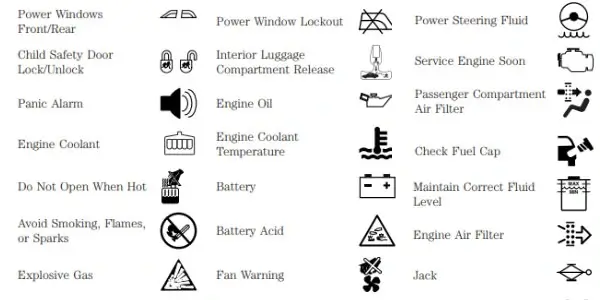
Green & Blue Indicator Lights (Informational)
- Green headlight icon: low beams on.
- Blue headlight icon: high beams on. Dim for oncoming traffic.
- Green arrows: turn signal or hazards.
- Cruise / SET: cruise control active.
If any stays on when the feature is off, mention it at your next service.
What to Do When a Light Comes On (Decision Flow)
- Is it red? Pull over within the next minute and stop the engine. Check the relevant fluid once cool. Do not drive if a red light returns after topping up.
- Is it the wrench? The Escape is likely in limp mode from the throttle body. Drive gently to a shop and have the codes read.
- Is it the check engine light and flashing? Active misfire, get to a shop today.
- Is it the steering light? Check for open recalls and have it diagnosed, the steering can go heavy.
- Is it amber and steady (ABS, TPMS, airbag)? Note it and schedule diagnosis within the week.
- Is it green or blue? No action.
How Much It Costs to Diagnose
| Service | DIY Cost | Shop Cost (US avg) | Time |
|---|---|---|---|
| OBD2 code scan | $25-40 (scanner) | Free at parts stores; $80-150 at shop | 5-15 min |
| Throttle body cleaning | $10 (cleaner) | $90-160 | 30-60 min |
| Throttle body replacement | $120-250 (part) | $300-550 | 1-1.5 hrs |
| Fuel cap replacement | $15-25 | $30-60 | 2 min |
| Wheel speed sensor | $30-80 (part) | $150-300 | 30-60 min |
| Power steering diagnosis | – | $90-160 | 30-60 min |
| Coolant leak diagnosis | – | $80-150 | 30-90 min |
Cost ranges are US averages from RepairPal and owner-reported data. A documented recall repair (such as steering) may be covered at no charge, so always check your VIN first.
Frequently Asked Questions
Q: What does the wrench light mean on a 2010 Ford Escape?
A: The wrench is Ford’s powertrain malfunction light, not a service reminder. On the 2010 Escape it most often means the electronic throttle body has faulted and put the vehicle into reduced-power limp mode. You can usually drive gently to a shop, but have the codes read, the throttle body is the most common cause on these years.
Q: Why is my 2010 Escape’s steering suddenly heavy with a warning light?
A: The 2010 Escape uses electric power steering, and a steering warning means the assist has faulted, which can make the wheel hard to turn. This generation had a steering-related recall, so check whether your VIN has an open recall (it may be a free repair) and have the system diagnosed promptly.
Q: Can I drive my 2010 Escape with the wrench light on?
A: Usually yes, but gently and only to a shop. In limp mode the Escape limits power to protect the drivetrain, so acceleration is slow and the top speed is capped. Driving long distances like this risks further damage, so get the throttle body and codes checked soon.
Q: My 2010 Escape check engine light is on. Where do I start?
A: Tighten the fuel cap until it clicks and drive for a day, a loose cap is a common harmless cause. If it stays on, have the codes read for free at an auto parts store. On higher-mileage Escapes, a P0420 catalyst code is common. A flashing check engine light means an active misfire, get to a shop the same day.
Q: Is the 2010 Ford Escape ABS light dangerous?
A: Your normal brakes still work with the ABS light on, so stopping distance is unaffected in routine driving. You only lose anti-lock function during a hard, panic stop. The usual cause on this Escape is a corroded wheel-speed sensor, have it scanned and repaired soon.
Q: How do I reset the tire pressure light on a 2010 Escape?
A: Inflate all four tires to the pressure on the driver’s door jamb, then drive for several minutes so the system relearns. If the light stays on after the tires are correct, a TPMS sensor battery may be dead, these last about 5 to 7 years.
Sources & References
- Ford Motor Company, 2010 Ford Escape Owner’s Manual (owner.ford.com)
- Ford Technical Service Bulletins covering the electronic throttle body and electric power steering
- NHTSA recall and complaint database for the 2010 Ford Escape (nhtsa.gov)
- RepairPal average repair cost estimates for the Ford Escape
- OBD-II code definitions (P0420, P0455) per SAE J2012
Related articles on CarsDailyHub:
– Complete Guide to All Car Dashboard Warning Lights
– Ford Escape Dashboard Warning Lights (2013-2024)
– Ford Edge Dashboard Symbols and Meanings
– Ford Dashboard Symbols and Their Meanings
– How to Use an OBD2 Scanner