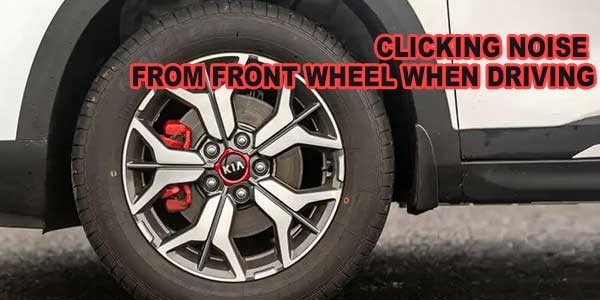
Clicking Noise from Front Wheel When Driving: Causes & Fix

By the CarsDailyHub Editorial Team | Automotive writers; every article fact-checked against OEM service documentation and RepairPal cost data | Updated June 2026
Quick Answer: A clicking noise from the front wheel while driving is most commonly caused by a failing CV joint (constant velocity joint), which produces a clicking sound that gets faster as vehicle speed increases. The second most common cause is a worn wheel bearing. If the clicking only happens when turning, it is almost certainly a CV joint. If it gets louder with speed and changes pitch on different road surfaces, it is likely a wheel bearing. Average repair cost: $150-400 for a CV axle, $120-300 for a wheel bearing.
This guide covers clicking noise diagnosis for front-wheel-drive and all-wheel-drive vehicles. Last reviewed: June 2026.
Table of Contents
- What Causes a Clicking Noise from the Front Wheel?
- All Possible Causes Ranked by Likelihood
- How to Diagnose Which Cause Applies to You
- How to Fix Each Cause
- Can You Continue Driving With This?
- Average Repair Costs
- How to Prevent Clicking Noise from Returning
- Frequently Asked Questions
- Sources & References
What Causes a Clicking Noise from the Front Wheel?
A clicking noise from the front wheel happens when a rotating component is worn or damaged and produces a rhythmic sound that syncs with wheel speed. As the wheel turns faster, the clicking speeds up. The specific component causing the noise determines when you hear it (turning vs. straight, accelerating vs. coasting) and what other symptoms accompany it.
The front wheel assembly has several rotating components that can produce clicking: the CV joint, the wheel bearing, the brake caliper, the strut mount, and the tire itself. Each has a distinct noise pattern that helps you identify the culprit without removing anything.
All Possible Causes Ranked by Likelihood
| Cause | Likelihood | Noise Pattern | Urgency | DIY Difficulty |
|---|---|---|---|---|
| Failing CV joint | Very high | Clicking when turning, speeds up with vehicle speed | 🟡 Fix soon | Medium |
| Worn wheel bearing | High | Humming/grinding that gets louder with speed, changes on turns | 🟡 Fix soon | Hard |
| Loose or stuck brake caliper | Medium | Clicking at low speed, may stop when braking | 🟡 Fix soon | Medium |
| Worn strut mount | Medium | Clunking over bumps, not speed-related | 🟡 Fix soon | Hard |
| Damaged tire (tread separation) | Low | Thumping or clicking that changes on different surfaces | 🔴 Replace now | Easy |
| Loose wheel lug nuts | Rare but critical | Clicking or clunking, steering wheel vibration | 🔴 Stop now | Easy |
| Foreign object in wheel | Rare | Clicking at low speed, visible on inspection | ℹ️ Remove | Easy |
How to Diagnose Which Cause Applies to You
Use this decision tree to narrow down the cause before you touch a tool:
Test 1: Does the clicking change when you turn left or right?
-
Clicking gets louder when turning one direction, quieter when turning the other: This is the classic CV joint symptom. The clicking is loudest when turning toward the side with the bad CV joint. For example, if the clicking gets louder when turning left, the right CV joint is likely bad (the load shifts to the outside wheel). Diagnosis: CV joint.
-
Clicking does not change when turning: The noise is probably not a CV joint. Move to Test 2.
Test 2: Does the clicking get louder with speed?
-
Yes, it gets louder and faster as speed increases: This points to a wheel bearing or tire issue. Move to Test 3.
-
No, it is only at low speed or over bumps: This points to a strut mount, loose brake component, or suspension issue.
Test 3: Does the pitch change on different road surfaces?
-
Yes, the noise changes on smooth vs. rough pavement: This indicates a tire issue (tread separation or cupping). Inspect the tire for visible damage.
-
No, the noise is consistent regardless of road surface: This indicates a wheel bearing. The noise is generated by the bearing itself and is not affected by the road surface.
Test 4: Does the clicking stop when you apply the brakes?
-
Yes, the clicking stops when braking: The brake caliper may be loose or the brake pads may be worn. Inspect the brake hardware.
-
No, the clicking continues when braking: The issue is not brake-related. Go back to Tests 1-3.
Test 5: Visual inspection
-
Check for a torn CV boot. Look behind the front wheels at the rubber boots on the axle shafts. If a boot is torn, cracked, or greasy, the CV joint inside is likely failing because dirt has entered and grease has escaped.
-
Check for loose lug nuts. Use a lug wrench to verify all lug nuts are tight. Loose lug nuts are rare but extremely dangerous.
-
Check for foreign objects. Look inside the wheel for rocks, debris, or a stuck brake dust shield that could be contacting the rotor.
-
Check tire condition. Look for bulges, uneven wear, or tread separation. Run your hand over the tire surface (when cool) to feel for bumps or cupping.
How to Fix Each Cause
Fix 1: CV Joint / CV Axle Replacement
The CV joint is part of the CV axle (half shaft) assembly. When the CV boot tears, grease escapes and dirt enters, destroying the joint. The clicking sound is the damaged bearing surfaces inside the joint.
The fix is to replace the entire CV axle assembly, not just the boot. By the time the joint is clicking, the damage is done. Rebooting a clicking joint will not fix the noise.
DIY steps (intermediate):
1. Loosen the lug nuts on the affected wheel (do not remove yet).
2. Jack up the vehicle and support on jack stands.
3. Remove the wheel.
4. Remove the axle nut (large, usually 30-36mm, may require a breaker bar or impact wrench).
5. Separate the lower ball joint from the steering knuckle (use a ball joint separator tool).
6. Pull the steering knuckle outward to free the outer CV joint from the hub.
7. Pry the inner CV joint from the transmission (use a pry bar).
8. Remove the old axle.
9. Install the new CV axle (reverse order). Push the inner end into the transmission until it clicks.
10. Reinstall the axle nut, wheel, and lower the vehicle.
11. Torque the axle nut to spec (critical, usually 100-200 ft-lbs depending on vehicle).
Cost: $50-120 (part) DIY; $150-400 at a shop. Time: 1-2 hours. Tools: Jack, jack stands, 30-36mm socket, breaker bar, ball joint separator, torque wrench.
Fix 2: Wheel Bearing Replacement
A worn wheel bearing produces a humming, grinding, or clicking noise that gets louder with speed. The noise may change when turning (loading and unloading the bearing).
DIY steps (advanced):
Wheel bearing replacement varies significantly by vehicle. Some use bolt-in hub assemblies (easier), others use press-in bearings (requires a hydraulic press or special tool).
For bolt-in hub assemblies:
1. Remove the wheel and brake caliper.
2. Remove the brake rotor.
3. Disconnect the ABS sensor.
4. Remove the three or four bolts holding the hub assembly.
5. Remove the old hub (may require a slide hammer if corroded).
6. Install the new hub assembly, torque bolts to spec.
7. Reconnect ABS sensor, brake rotor, caliper, and wheel.
Cost: $50-150 (part) DIY; $200-500 at a shop. Time: 1-3 hours. Tools: Jack, jack stands, socket set, slide hammer (if needed), torque wrench.
Fix 3: Brake Caliper or Hardware
If the clicking stops when braking, the brake caliper may be loose or the pads may be worn.
- Remove the wheel and inspect the brake caliper bolts. Tighten if loose.
- Check the brake pad thickness. Replace if worn below 3mm.
- Check the caliper slide pins. If seized, clean and lubricate with silicone brake grease.
- Check the anti-rattle clips and shims. Replace if missing or damaged.
Cost: $10-30 (hardware) DIY; $80-150 at a shop. Time: 30-60 min.
Fix 4: Tire Replacement
If the tire has tread separation, bulges, or severe cupping, replace it immediately. A tire with tread separation can fail catastrophically at highway speed.
Cost: $80-200 per tire. Time: 30 min at a tire shop.
Can You Continue Driving With This?
| Cause | Safe to Drive? | Max Distance | Risk of Ignoring |
|---|---|---|---|
| Failing CV joint | Short distances only | A few days | Axle can break, causing loss of power and potential accident |
| Worn wheel bearing | Short distances only | A few days | Bearing can seize, causing wheel lockup |
| Loose brake caliper | No | Tow it | Caliper can fall off or jam the wheel |
| Worn strut mount | Yes, carefully | Weeks | Poor handling, accelerated tire wear |
| Damaged tire | No | Replace now | Tire blowout at speed |
| Loose lug nuts | No | Stop immediately | Wheel can detach from vehicle |
| Foreign object | Yes | Remove when convenient | Minor, object may damage wheel or rotor |
The golden rule: If the clicking is getting louder or faster over time, the component is degrading. What starts as a minor noise can become a dangerous failure. A clicking CV joint can progress to a snapped axle in days or weeks. A grinding wheel bearing can progress to a seized wheel. Do not delay.
Average Repair Costs
| Cause | DIY Cost | Shop Cost (US avg) | Time |
|---|---|---|---|
| CV axle replacement | $50-120 (part) | $150-400 | 1-2 hrs |
| Wheel bearing (hub assembly) | $50-150 (part) | $200-500 | 1-3 hrs |
| Wheel bearing (press-in) | $50-100 (part) | $300-700 | 2-4 hrs |
| Brake caliper hardware | $10-30 (parts) | $80-150 | 30-60 min |
| Strut mount replacement | $30-80 (part) | $200-400 | 2-3 hrs |
| Tire replacement | $80-200 (per tire) | $80-200 + mount/balance | 30 min |
| Lug nut tightening | $0 | $0 | 5 min |
Cost ranges are US averages from RepairPal and owner-reported data.
How to Prevent Clicking Noise from Returning
-
Inspect CV boots at every oil change. A torn CV boot is the precursor to CV joint failure. If you catch a torn boot before the joint starts clicking, you can replace just the boot ($20-40) instead of the entire axle ($50-120). Look behind both front wheels for cracked, torn, or greasy rubber boots.
-
Replace wheel bearings at the first sign of noise. A wheel bearing that is humming will eventually grind and then seize. Early replacement is cheaper and safer.
-
Rotate tires every 5,000-7,000 miles. This prevents cupping and uneven wear that can cause tire noise.
-
Torque lug nuts properly. Always use a torque wrench, not an impact gun, when reinstalling wheels. Over-tightening warps brake rotors, under-tightening allows the wheel to loosen.
-
Have the alignment checked annually. Poor alignment accelerates tire wear and suspension component wear, both of which can cause noise.
Frequently Asked Questions
Q: Is a clicking noise from the front wheel dangerous?
A: It depends on the cause. A clicking CV joint is not immediately dangerous but will progress to axle failure if ignored. A loose lug nut or damaged tire is immediately dangerous and should be addressed before driving further. If the clicking is getting louder or faster over time, the component is degrading and you should have it diagnosed within days, not weeks.
Q: How do I know if it is a CV joint or a wheel bearing?
A: The key difference is when the noise occurs. A CV joint clicks loudest when turning (the joint is loaded on the outside wheel) and the clicking speeds up with vehicle speed. A wheel bearing produces a humming or grinding noise that gets louder with speed but does not change much when turning. If the clicking stops when turning one direction and gets louder when turning the other, it is a CV joint. If the noise is consistent regardless of steering input, it is likely a wheel bearing.
Q: Can I drive with a clicking CV joint?
A: You can for a short time, but not for long. A clicking CV joint is already damaged. The clicking will get louder and faster as the joint degrades further. Eventually the joint will bind or break, causing the axle to snap. When that happens, you lose power to that wheel and the vehicle may pull sharply. Have it replaced within days, not weeks. Do not drive on highways with a clicking CV joint.
Q: How much does it cost to fix a clicking CV joint?
A: The fix is to replace the entire CV axle assembly, not just the joint. A CV axle costs $50-120 for the part. At a shop, the total cost including labor is $150-400 depending on the vehicle. The job takes 1-2 hours for a DIYer with basic tools. You need a jack, jack stands, a large socket for the axle nut (usually 30-36mm), and a torque wrench.
Q: Can a bad tire cause a clicking noise?
A: Yes. Tread separation, cupping, and uneven wear can all produce clicking, thumping, or humming noises. The key difference from a CV joint or wheel bearing is that tire noise changes on different road surfaces. If the noise gets quieter on smooth pavement and louder on rough pavement, inspect the tire for damage. Run your hand over the tire surface (when cool) to feel for bumps, cupping, or separated tread.
Q: Why does the clicking noise stop when I brake?
A: If the clicking stops when you apply the brakes, the noise is likely coming from the brake system, not the CV joint or wheel bearing. The most common cause is a loose brake caliper, worn brake pads, or a missing anti-rattle clip. Inspect the brake caliper bolts, pad thickness, and hardware. This is a simpler and cheaper fix than a CV axle or wheel bearing.
Sources & References
- RepairPal – Average repair cost estimates for CV axle and wheel bearing replacement by vehicle
- NHTSA – Vehicle complaint database for tire and wheel-related issues (nhtsa.gov)
- Tire Industry Association – Tire inspection guidelines
- SAE J2012 – OBD-II Diagnostic Trouble Code definitions (if applicable)
- ASE (National Institute for Automotive Service Excellence) – Suspension and steering certification reference materials
Related articles on CarsDailyHub:
– Car Problem Solver: Complete Symptom Guide
– Why My Car Makes Noise When Turning Right but Not Left
– Car Making Noise When AC Is On: Causes & Fix
– Car Makes Rattling Noise When Accelerating: Causes & Fix
– Does a Bad Water Pump Make Noise?