
Subaru Forester CVT Transmission Problems: Causes and Fixes

By the CarsDailyHub Editorial Team | Automotive writers; every article fact-checked against OEM service documentation and owner-reported data | Updated June 2026
Quick Answer: The Subaru Forester uses Subaru’s Lineartronic CVT, and the most reported problems are a shudder or judder during light acceleration, hesitation or jerking, a whining noise, and, in some cases, overheating. Earlier model years (around 2014-2018) drew the most complaints, and Subaru extended the CVT warranty on many of those vehicles. Many issues are addressed with software updates and the correct CVT fluid service; severe cases may need valve body or full CVT replacement. Check your warranty status before paying.
This guide covers CVT problems on the Subaru Forester, with emphasis on the years that drew the most complaints. Last reviewed: June 2026.
Table of Contents
- About the Lineartronic CVT
- Common Forester CVT Problems and Symptoms
- Which Model Years Are Affected
- What Causes Forester CVT Problems
- How These Problems Get Fixed
- Warranty Extension
- How to Make a CVT Last Longer
- Frequently Asked Questions
- Sources & References
About the Lineartronic CVT
Subaru calls its continuously variable transmission Lineartronic. Like other CVTs, it uses a steel chain or belt between two variable pulleys to give a seamless range of ratios, which improves fuel economy and pairs well with Subaru’s symmetrical all-wheel drive. On the whole, the Lineartronic has held up better than some rival CVTs, but it is still sensitive to fluid condition and heat, and that is where most Forester complaints originate.
Common Forester CVT Problems and Symptoms
| Symptom | What owners describe |
|---|---|
| Shudder / judder | A shake during light acceleration, like rumble strips |
| Hesitation / jerking | A pause or lurch when you press the gas |
| Whining noise | A rising whine with engine speed (some is normal) |
| RPM flaring | Revs climb without matching acceleration |
| Overheating / reduced power | Loss of power under sustained load or heat |
| Delayed engagement | A pause before the car moves after selecting Drive |
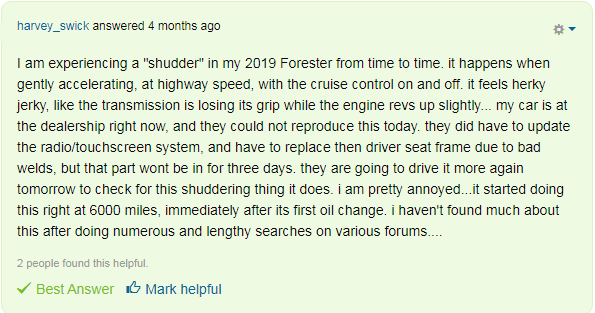
The shudder during gentle acceleration is the most discussed, and like other CVTs it ties back to fluid and the torque converter.
Which Model Years Are Affected
Forester CVT complaints cluster most around the 2014-2018 model years, the period that also saw a broader Subaru CVT warranty extension. Subaru made running improvements over time, so later Foresters are generally more robust. Any CVT-equipped Forester, though, benefits from careful fluid maintenance and prompt attention to symptoms. If you are buying used, weigh the CVT service history and any remaining extended-warranty coverage heavily.
What Causes Forester CVT Problems
- Fluid condition and heat: Degraded or overheated CVT fluid is the leading factor in shudder and slipping; the fluid carries heavy clamping loads and heat.
- Torque converter judder: A shudder at light throttle often traces to the converter clutch and fluid.
- Valve body / hydraulic faults: Cause harsh or erratic behavior and stored codes.
- Software calibration: Some shift-feel complaints are improved by control software updates.
- Deferred maintenance: Skipping fluid service shortens CVT life significantly.
How These Problems Get Fixed
- Scan for codes and check for stored CVT or overheat events.
- Check for software updates and TSBs. Subaru issued control updates that improve some shudder and shift-feel complaints, a dealer can apply what fits your VIN.
- Service the CVT fluid with the correct Subaru high-torque CVT fluid. Fresh, correct fluid resolves or reduces many shudder and slip cases, especially early. Never substitute a generic fluid.
- Valve body service for hydraulic faults.
- CVT replacement or rebuild in severe cases, which is the expensive worst case and the reason warranty coverage matters so much.
Catching symptoms early greatly increases the chance that a fluid service and software update prevent a major repair.
Warranty Extension
Because of CVT concerns on certain model years, Subaru extended the CVT warranty on many affected vehicles beyond the standard powertrain term. Coverage varies by model year and market, so contact a Subaru dealer with your VIN and ask whether your Forester has any extended CVT coverage or applicable campaign. A covered repair can save you thousands, so always check before paying out of pocket for CVT work.
How to Make a CVT Last Longer
- Service the fluid regularly, and more often than “lifetime” claims suggest, especially with towing within limits, hilly terrain, or hot climates.
- Use only the correct Subaru CVT fluid.
- Avoid overheating: ease off on long climbs and do not exceed towing limits.
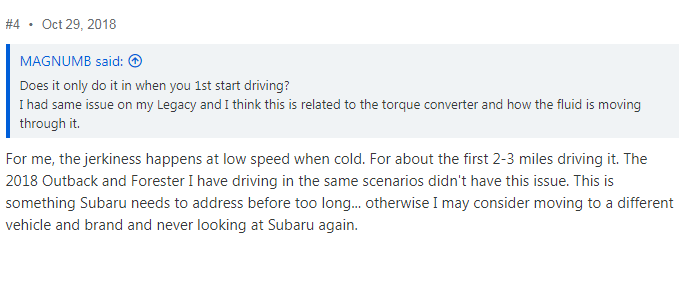
- Let it warm up briefly in very cold weather before hard acceleration.
- Address symptoms early: a small shudder caught now can save the transmission later.
Frequently Asked Questions
Q: Why does my Subaru Forester shudder when accelerating?
A: A shudder or judder during light acceleration is one of the most common Forester CVT symptoms, and it usually traces to degraded or overheated CVT fluid and the torque converter. Servicing with the correct Subaru CVT fluid often reduces or resolves it when caught early, and a dealer should check for any applicable software update. If it persists after a fluid service, the transmission needs a closer inspection.
Q: What years of Subaru Forester have CVT problems?
A: Complaints cluster most around the 2014-2018 model years, which also saw Subaru’s broader CVT warranty extension. Subaru improved the design over time, so later Foresters are generally more robust. If buying a used Forester, check the CVT service history and whether it still has any extended-warranty coverage by VIN.
Q: Does Subaru cover the CVT under an extended warranty?
A: Subaru extended the CVT warranty on many affected vehicles beyond the standard term because of the concerns on certain model years. Coverage depends on the model year and market, so contact a Subaru dealer with your VIN to confirm whether your Forester qualifies. A covered CVT repair can save thousands, so always check before paying yourself.
Q: Is it safe to drive with a Forester CVT shudder?
A: A mild shudder is usually safe to drive on short term, but it is a signal not to ignore, because continued operation with degraded fluid can worsen wear. Have it diagnosed promptly so a fluid service and any software update can be applied early. If the car overheats the CVT, slips, or loses power, stop and have it checked rather than continuing.
Q: Can I change the Forester CVT fluid myself?
A: You can service the fluid if you use the exact Subaru high-torque CVT fluid and follow the correct fill and level procedure, which is more particular than a regular automatic. Never substitute a generic CVT fluid, as the wrong fluid can quickly damage the transmission. If you are unsure about the level-check procedure, have a dealer or specialist do it.
Sources & References
- Subaru service information for the Lineartronic CVT and high-torque CVT fluid specifications
- Subaru CVT warranty extension communications (confirm by VIN with a dealer)
- NHTSA complaint database for the Subaru Forester (nhtsa.gov)
- Owner-reported reliability and repair data
Related articles on CarsDailyHub:
– Transmission and Drivetrain: Complete Guide
– Hyundai Tucson Hybrid Transmission Problems
– Nissan Altima CVT Transmission Problems
– Honda CVT Transmission Problems