

How to Test Cold Cranking Amps With a Multimeter: Step-by-Step Guide

By the CarsDailyHub Editorial Team | Automotive writers; every article fact-checked against battery manufacturer specifications and OEM service documentation | Updated June 2026
This guide covers testing a 12V automotive battery’s cranking ability using a digital multimeter. Specifications reference Battery Council International (BCI) standards and battery manufacturer data. Last reviewed: June 2026.
What Cold Cranking Amps Actually Mean
Cold cranking amps (CCA) is a rating that describes a battery’s ability to start an engine in cold conditions. The BCI standard defines it as: the number of amps a 12V battery can deliver for 30 seconds at 0°F (-18°C) while maintaining at least 7.2 volts.
The key word is cold. Engine oil thickens at low temperatures, increasing the mechanical resistance the starter motor has to overcome. At the same time, the chemical reactions inside the battery slow down in the cold, reducing its ability to deliver current. CCA captures both of those realities in one number.
A typical passenger car needs 400-600 CCA. Trucks, large SUVs, and diesel engines need 700-1,000+ CCA. The rating is printed on the battery label, if yours says “600 CCA,” that’s the benchmark you’re testing against.
Why CCA matters more in cold climates: If you live somewhere that regularly drops below freezing, CCA is the single most important battery spec. A battery that starts a 4.0L V6 effortlessly at 70°F may struggle to turn the same engine at 10°F because its effective CCA has dropped by 30-40%. As batteries age, their CCA declines, a 3-year-old battery rated at 600 CCA may only deliver 350-400 in real terms.
Tools You Need
| Tool | Purpose | Cost |
|---|---|---|
| Digital multimeter | Measure voltage during cranking | $20-50 |
| Battery load tester (optional but recommended) | Direct CCA / load test | $30-60 |
| Safety glasses | Eye protection near battery | $5-10 |
| Helper (one person) | Crank engine while you read the meter | Free |
Multimeter settings: Set to DC volts (V⎓), 20V range. Most automotive multimeters have a 20V DC setting, that’s the one you want. Do not use the 200V range; it’s less precise at the 10-12V readings you’re measuring.
A note on multimeter quality: A $20 digital multimeter from a hardware store is accurate enough for this test. You don’t need a Fluke. What you do need is a meter with a “min/max” or “hold” function, the voltage drops and recovers in under a second during cranking, and a meter without a hold function may not capture the lowest point.
The Honest Limitation: Multimeter vs Load Tester
Let’s be direct about what a multimeter can and cannot do:
A multimeter measures voltage, not current. Cold cranking amps is a current measurement (amps, not volts). Most consumer multimeters have a 10-amp current mode, but cranking a starter motor draws 100-400 amps, far beyond what a multimeter can measure. If you try to measure cranking current through a multimeter set to amps, you’ll blow the meter’s fuse instantly.
What you can measure: The voltage sag during cranking. A battery’s voltage drops under load, and how far it drops tells you whether the battery can deliver its rated current. This is an indirect test, you’re inferring CCA health from voltage behavior, not measuring CCA directly.
For a direct CCA reading: You need a battery load tester or a conductance tester. A load tester applies a fixed resistive load (typically half the CCA rating) for 15 seconds and measures whether the voltage stays above 9.6V. A conductance tester (like the Midtronics or Solar BA series) sends a small AC signal through the battery and calculates internal resistance, it gives a CCA estimate in seconds without cranking. Both cost $30-60 and are the right tool if you test batteries regularly.
The multimeter method below is a good-enough field test that tells you whether to replace the battery or look elsewhere for a starting problem. It’s not a lab-grade CCA measurement.
Method 1: Voltage Drop Test During Cranking (Two People)
This is the most informative multimeter test. It measures how far the battery voltage drops under the actual load of the starter motor.
Preparation:
- Park on level ground, turn off all electrics (radio, AC, lights, heater fan).
- Open the hood and locate the battery terminals.
- Set your multimeter to DC volts, 20V range.
- Connect the red probe to the positive battery terminal (+).
- Connect the black probe to the negative battery terminal (−).
- Note the resting voltage, a healthy battery reads 12.4-12.7V. Below 12.3V, charge the battery before testing; a low battery will fail the cranking test regardless of CCA health.
The test (requires two people):
- Have your helper sit in the driver’s seat.
- You stand at the battery with your eyes on the multimeter.
- Your helper turns the key to crank the engine (or presses the start button while holding the brake).
- Watch the voltage during cranking, this is the critical reading. The voltage will dip the moment the starter engages, then recover as the engine catches.
- If your multimeter has a “min/max” or “hold” function, press it before cranking so the lowest voltage is captured. The dip happens fast, under 1 second, and is easy to miss on a meter without hold.
Reading the result:
| Voltage During Crank | Battery Condition | Action |
|---|---|---|
| Above 10.0V | Healthy, battery delivers full CCA | No action needed |
| 9.6-10.0V | Borderline, CCA reduced but functional | Monitor; test again in cold weather |
| 8.5-9.6V | Weak, CCA significantly reduced | Replace if winter is approaching |
| Below 8.5V | Failed, cannot deliver rated CCA | Replace battery |
| Below 5.0V | Dead cell or severe sulfation | Replace immediately |
The “dip and recover” pattern: A healthy battery drops to 10-11V the instant the starter engages, then climbs back to 13.5-14.5V once the engine is running (the alternator takes over). If the voltage drops to 10V and stays there during cranking but the engine starts, the battery is borderline. If it drops below 9V and the engine cranks slowly or not at all, the battery can’t deliver its rated CCA.
Important: This test assumes the starter motor and engine are healthy. A failing starter that draws excessive current, or an engine with internal mechanical drag (carbon buildup, partial seizure), can pull the voltage down even with a good battery. If the battery passes a load test but still fails the cranking test, the starter or engine is the problem, not the battery.
Method 2: Static Voltage Test (Quick Health Check)
If you don’t have a helper, this 30-second test tells you the battery’s state of charge, not its CCA, but whether it’s worth testing further.
- Turn off the engine and all electrics. Wait at least 1 hour after driving for the surface charge to dissipate (a battery reads artificially high right after the alternator has been charging it).
- Set the multimeter to DC volts, 20V range.
- Connect red to positive, black to negative.
- Read the voltage.
| Resting Voltage | State of Charge | Interpretation |
|---|---|---|
| 12.6V or above | 100% | Fully charged, proceed to cranking test |
| 12.4-12.5V | 75-90% | Good, proceed to cranking test |
| 12.2-12.3V | 50-70% | Low, charge before testing CCA |
| 12.0-12.1V | 25-40% | Discharged, charge and retest |
| Below 12.0V | Below 25% | Dead or failing, may not accept charge |
A battery at 12.0V is not “12 volts” in any meaningful sense, it’s deeply discharged. A healthy 12V automotive battery at rest reads 12.6V because it’s actually six 2.1V cells in series. If you read 10.5V or lower, you likely have a shorted cell (one cell at 0V instead of 2.1V) and the battery is permanently bad, no amount of charging will fix it.
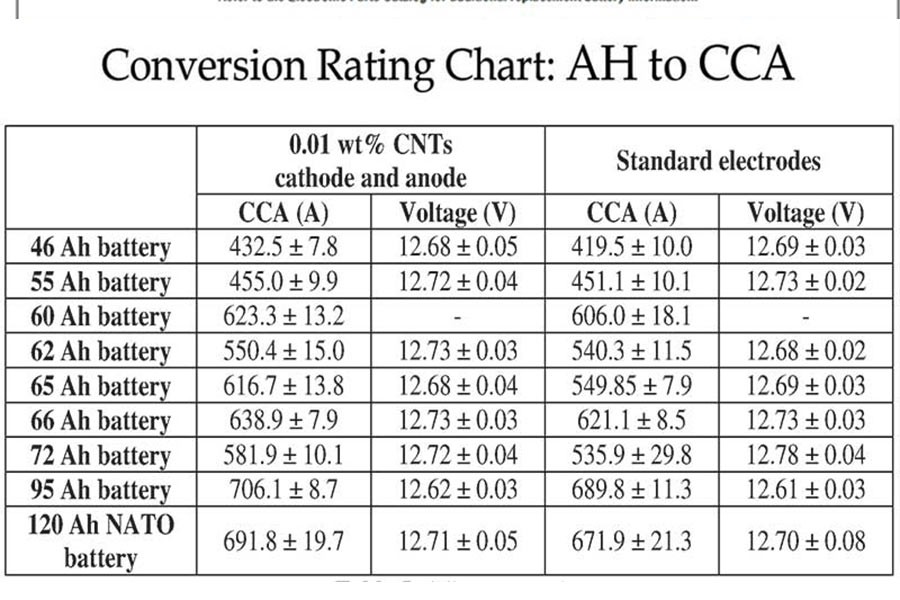
Method 3: Converting CCA to Amp-Hours (Capacity Estimate)
This isn’t a test, it’s a calculation that helps you estimate battery capacity (amp-hours, Ah) from the CCA rating. It’s useful when comparing batteries or sizing a replacement.
The rule of thumb: Divide CCA by 7.25 to get an approximate Ah rating.
Ah ≈ CCA ÷ 7.25
Example: A battery rated at 600 CCA: Ah ≈ 600 ÷ 7.25 ≈ 82.8 Ah
The reverse (Ah to CCA): multiply Ah by 7.25. CCA ≈ Ah × 7.25
Example: A 100 Ah battery: CCA ≈ 100 × 7.25 = 725 CCA
Important caveat: This is an approximation, not a specification. CCA and Ah measure different things, CCA is a short-duration cold-start rating, Ah is a long-duration capacity rating. The 7.25 factor is a rough industry heuristic, not a conversion constant. Two batteries with the same CCA can have different actual Ah capacities depending on plate design and chemistry. Use this for estimation only, never for sizing a critical system.
Reading Your Results: Voltage Chart
Combine the static and cranking tests for a full picture:
| Resting Voltage | Cranking Voltage | Diagnosis |
|---|---|---|
| 12.6V | 10.5V+ | Healthy battery, healthy starter |
| 12.6V | 9.0-9.5V | Battery CCA declining, replace before winter |
| 12.6V | Below 8.5V | Battery failed or starter drawing too much, load-test both |
| 12.3V | 10.0V+ | Undercharged, charge and retest |
| 12.0V | Below 9.0V | Discharged or failing, charge, then retest; if it won’t hold 12.4V+, replace |
| 10.5V | Won’t crank | Shorted cell, replace battery |
| 12.6V | 11.0V+ but slow crank | Battery fine, starter or engine issue |
When to Replace the Battery
Replace the battery if any of these are true:
- Cranking voltage drops below 9.6V at room temperature (70°F / 21°C)
- Cranking voltage drops below 8.5V at 0°F (-18°C)
- Resting voltage won’t rise above 12.3V after a full charge (8+ hours on a charger)
- The battery is 4+ years old and you live in a cold climate
- A conductance tester rates the battery below 70% of its labeled CCA
- You see visible swelling, corrosion at the terminals that won’t clean off, or a rotten-egg smell (sulfation or internal short)
Age matters more than any single test. Most automotive batteries are designed for 3-5 years of service. If yours is past 4 years and you’re seeing any starting hesitation in cold weather, replace it proactively, don’t wait for a no-start at 6 AM in January. The cost of a tow and a roadside battery ($150-300) exceeds the cost of a proactive replacement ($120-200).
Common Mistakes That Give False Readings
Mistake 1, Testing immediately after driving. The alternator leaves a “surface charge” on the battery that reads 13.0-13.5V, artificially high. Wait at least 1 hour, or turn on the headlights for 2 minutes to burn off the surface charge, then test.
Mistake 2, Testing with the engine running. With the engine running, you’re reading alternator output (13.5-14.8V), not battery voltage. Always test with the engine off for static voltage, or only during cranking for the load test.
Mistake 3, Dirty or loose probe contact. Corrosion on the battery terminals creates resistance that throws off the reading. Clean the terminals with a wire brush and baking-soda solution before testing, and press the probes firmly against lead, not corrosion.
Mistake 4, Testing a discharged battery and calling it “bad.” A battery at 11.8V isn’t necessarily failed, it may simply be discharged. Charge it fully (8+ hours on a smart charger) and retest before condemning it. The most common false “bad battery” diagnosis comes from testing a battery that’s been sitting discharged for weeks.
Mistake 5, Ignoring the starter. A slow crank with good battery voltage (10.5V+ during crank) doesn’t mean the battery is weak, it means the starter is drawing too much current or the engine has mechanical drag. Replacing the battery won’t fix a worn starter. If the cranking voltage is healthy but the engine still cranks slowly, test the starter next.
Mistake 6, Measuring current through the multimeter. Never set your multimeter to the amps mode and connect it across the battery terminals while cranking. Starter current is 100-400 amps; your multimeter’s 10-amp fuse will blow instantly, and on some meters the meter itself can be damaged. Measure voltage only.
Frequently Asked Questions
Q: Can I test CCA with just a multimeter?
A: Not directly. CCA is a current measurement (amps), and most multimeters can only measure up to 10 amps, a starter draws 100-400 amps. What you can do with a multimeter is measure the voltage drop during cranking: a healthy battery stays above 9.6V while the engine cranks. If it drops below that, the battery can’t deliver its rated CCA. For a direct CCA number, use a battery load tester or conductance tester ($30-60).
Q: What’s the difference between CCA and CA (cranking amps)?
A: CCA (cold cranking amps) is measured at 0°F (-18°C). CA (cranking amps), sometimes called MCA (marine cranking amps), is measured at 32°F (0°C). CA numbers are always higher than CCA numbers for the same battery because the battery performs better at warmer temperatures. When comparing batteries, always compare CCA to CCA, never CCA to CA. A battery advertised as “800 CA” may only be 600 CCA.
Q: At what voltage is a 12V car battery dead?
A: A resting voltage below 12.0V means the battery is deeply discharged. Below 10.5V typically indicates a shorted cell (one of the six 2.1V cells has failed). A battery at 10.5V will not start an engine and usually cannot be recovered by charging, it needs replacement. A healthy, fully charged battery at rest reads 12.6V.
Q: How accurate is the CCA-to-Ah conversion (divide by 7.25)?
A: It’s a rough estimate, not a precise conversion. CCA measures short-duration cold-starting ability; Ah measures long-duration capacity. The 7.25 factor is an industry rule of thumb that works reasonably for typical flooded lead-acid car batteries, but it’s less accurate for AGM, gel, or deep-cycle batteries, which have different plate designs. Use it for estimation only, never for sizing a critical or standalone power system.
Q: Should I replace my battery if it fails the cranking test but passes a load test?
A: If the battery passes a proper load test (holds above 9.6V under a load equal to half its CCA for 15 seconds), the battery is healthy and the cranking problem is elsewhere, most likely the starter motor, battery cables, or engine mechanical drag. Don’t replace a battery that passes a load test. Instead, test voltage drop across the starter cables and have the starter’s current draw measured.
Q: How often should I test my car battery’s CCA?
A: Test it annually once the battery is 3 years old, and before every winter if you live in a cold climate. Most auto parts stores will run a free conductance test that gives you a CCA estimate and a “replace” or “good” verdict in 30 seconds. There’s no reason not to take advantage of this at every oil change once the battery is past mid-life.
Sources & References
- Battery Council International (BCI), CCA rating standard definition (BCI Standard 10)
- Interstate Batteries, Battery testing technical documentation
- Optima Batteries, AGM vs flooded CCA performance data
- Exide Technologies, Battery state-of-charge voltage charts
- SAE J537, Battery rating standards (CCA, CA, RC)
- RepairPal, Average car battery replacement cost by vehicle
Related articles on CarsDailyHub: